Almost every product team already uses AI in some form. According to Google’s 2025 DORA report, based on a survey of nearly 5,000 technology professionals, AI adoption among software developers has reached 90%. More than 80% say it has made them more productive.
Yet the same research shows a gap. Only 24% of respondents trust AI output “a lot” or “a great deal,” while 30% trust it little or not at all. DORA describes AI as a “mirror and a multiplier”: in cohesive organizations it boosts efficiency, and in fragmented ones it exposes existing weaknesses.
That is the real challenge for product leaders. Giving engineers a coding assistant is the easy part. Integrating AI into the way the whole team discovers, builds, tests and ships products, without slowing down delivery that already works, takes deliberate design.
Where AI fits across the product lifecycle
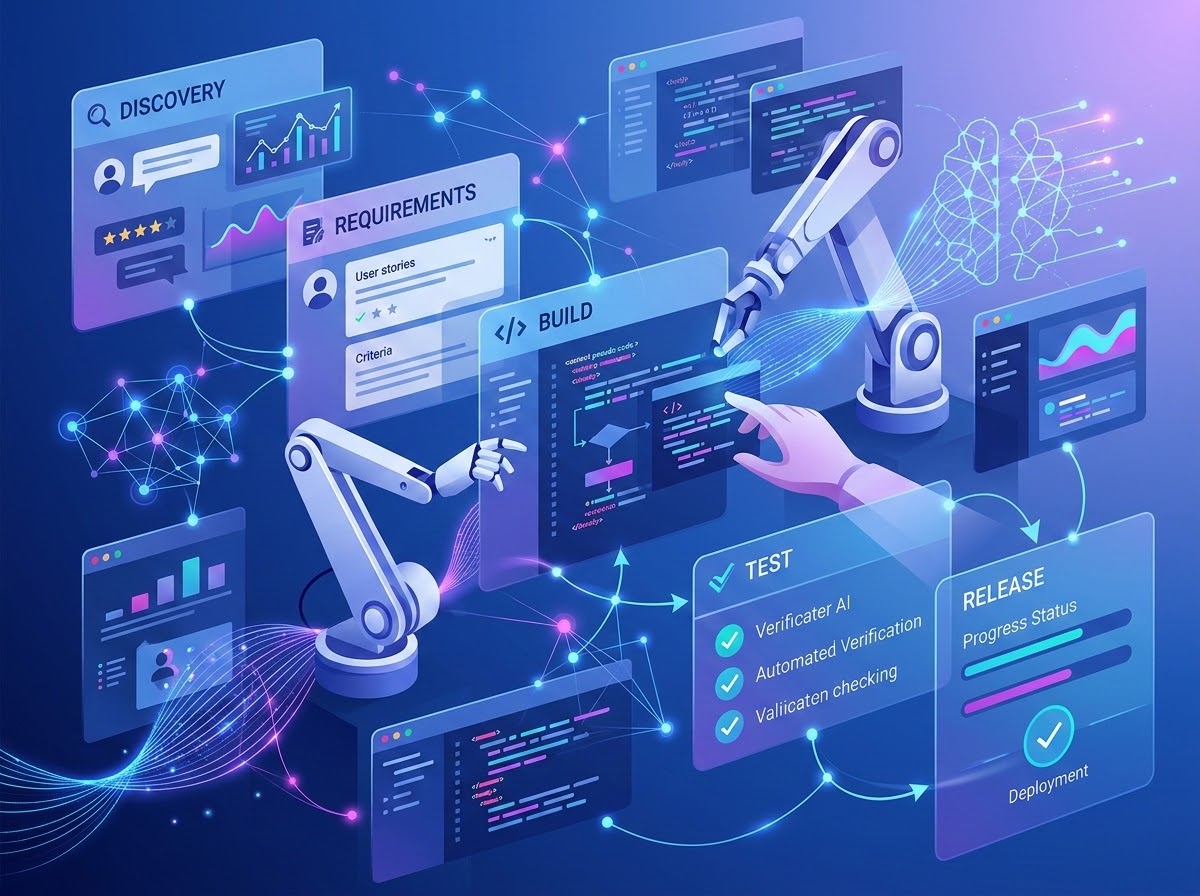
The biggest gains rarely come from a single tool. They come from applying AI at several points in the lifecycle, each with a clear owner and a human checkpoint.
| Stage | Where AI helps | Human checkpoint |
| Discovery | Summarizing user interviews, support tickets and reviews; clustering feedback into themes | Product managers decide which problems matter |
| Requirements | Drafting user stories and acceptance criteria; spotting gaps and edge cases | Team refines scope in backlog grooming |
| Design | Generating UI variants, prototypes and copy options | Designers choose and adapt |
| Development | Code completion, boilerplate, refactoring, explaining unfamiliar code | Code review by engineers |
| Testing | Generating test cases and scripts, test data, flaky-test analysis | QA validates coverage and critical paths |
| Release and operations | Release notes, log and incident analysis, anomaly detection | On-call engineers own decisions |
| Documentation | Keeping technical and user docs in sync with code | Tech writers or owners approve |
Starting with the stages that cause the most friction today usually pays off faster than starting with the most visible ones.
Six steps to integrate AI without disrupting delivery
- Map your current workflow first. Document how work actually moves from idea to production, and where it waits. Bottlenecks in review, testing or handoffs are often better targets than writing code faster.
- Pick two or three high-friction use cases. Choose problems with a measurable baseline, such as time spent writing tests or triaging bugs. Avoid starting with everything at once.
- Set guardrails before scaling. Decide which tools are approved, what data and code may be shared with them, and who owns AI-generated output. Clear policies on security and IP protection prevent shadow AI and later rework.
- Run a time-boxed pilot with one team. Four to eight weeks is usually enough to see whether a use case holds up in real work. Compare results against the baseline, not against expectations.
- Adapt your processes, not just your tools. AI-generated code still needs review, and faster output can overload testing. Adjust definitions of done, review practices and test automation so quality keeps pace with speed.
- Scale what works and train the team. Roll out proven use cases gradually, share prompts and patterns internally, and invest in training. Teams that understand where AI is strong and where it fails get far more from it.
Common pitfalls and how to measure impact
The mistakes that most often stall AI initiatives are predictable:
- Tool-first thinking. Buying licenses without a defined problem leads to low usage and unclear value.
- Speed without quality. More code shipped faster can mean more defects if testing and review don’t scale with it.
- Ignoring trust. If engineers don’t trust the output, they either redo the work or stop using the tools.
- Unclear data policies. Sensitive code or customer data shared with external tools creates security and compliance risks.
- Measuring activity, not outcomes. Counting prompts or accepted suggestions says little about business value.
To measure real impact, track the delivery metrics you already know: lead time for changes, deployment frequency, change failure rate and time to restore service. Add team-level signals such as developer satisfaction and time spent on repetitive work. If these improve, AI is working. If only usage goes up, it isn’t yet.
Building AI into the way you work
Integrating AI into product development is less a technology project than an operating model change. The teams that benefit most treat it like any other process improvement: they start from a real bottleneck, test carefully, and scale only what proves its value.
Many companies bring in outside expertise for the early stages, particularly for the roadmap and the guardrails. Engineering partners such as KMS Technology now offer AI roadmapping alongside AI-assisted development and testing, helping teams embed generative AI into their existing SDLC rather than building a parallel process next to it. Whether you work with a partner or build capability in-house, the principle is the same: AI should fit your workflow, not the other way around.
The goal isn’t to use more AI. It’s to ship better products, faster, with a team that trusts the tools it works with.