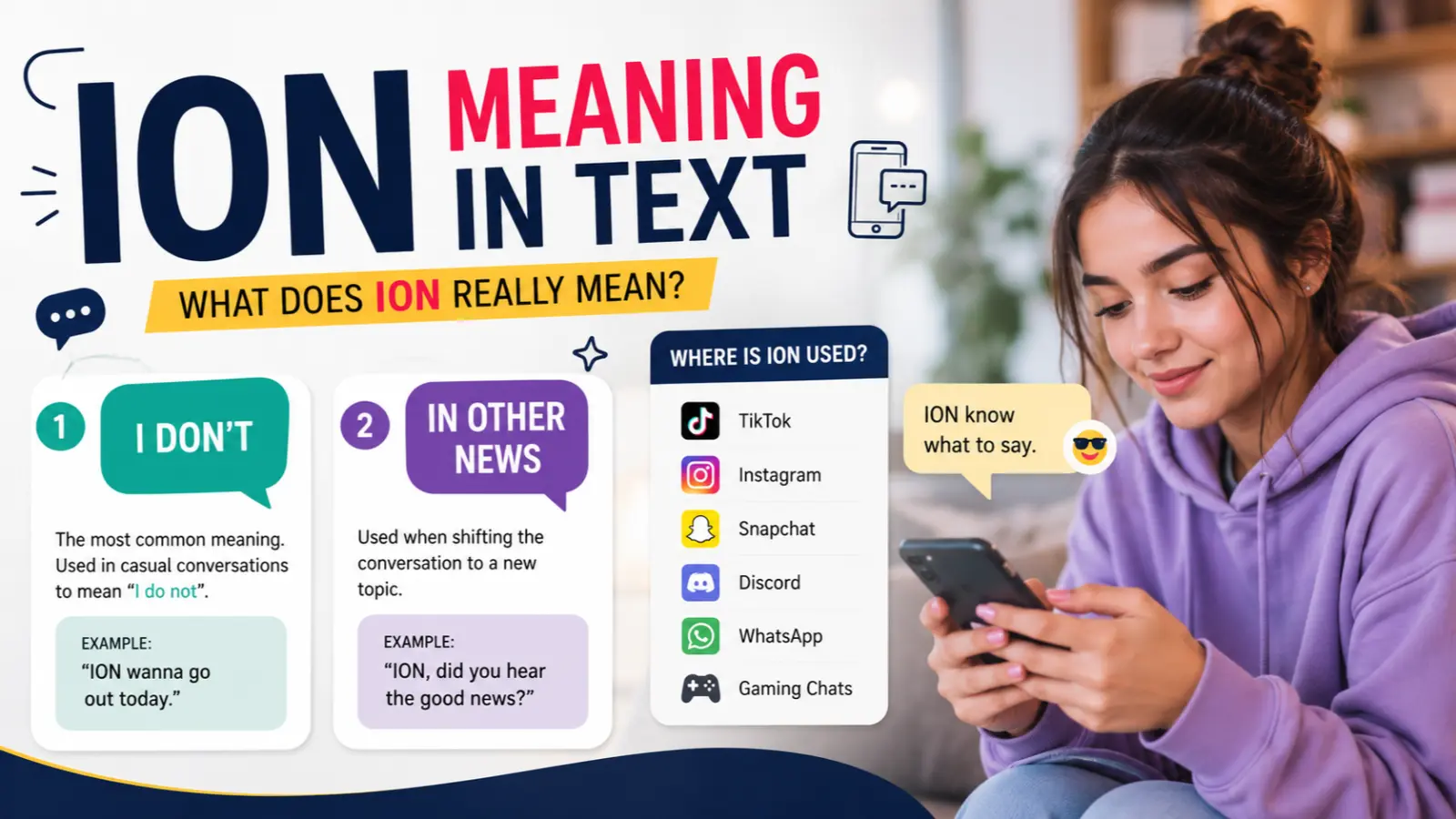
ION meaning is something many people search for when they see the term in text messages, TikTok comments, Snapchat chats, or online conversations. Internet slang changes quickly, and abbreviations like “ION” can have more than one meaning depending on the context.
Some people use ION casually while chatting with friends, while others use it on social media to change the topic or express emotions. Because of these different uses, understanding the exact meaning of ION is important before replying.
Whether you saw it in a meme, gaming chat, Instagram caption, or text message, this guide explains every common meaning of ION in simple English with examples and usage tips.
Quick Answer
ION usually means “I don’t” in texting slang.
It can also mean “In Other News” when someone wants to introduce a different topic in a conversation.
What does ION mean in text?
The slang term ION has multiple meanings online. The two most common meanings are:
- I don’t
- In Other News
The meaning depends entirely on the sentence and tone of the conversation.
For example:
- “ION know what happened.” → Means “I don’t know.”
- “ION, the game tonight was amazing.” → Means “In Other News.”
Because texting slang is informal, people often shorten phrases to type faster. That is why abbreviations like ION became popular on social media and messaging apps.
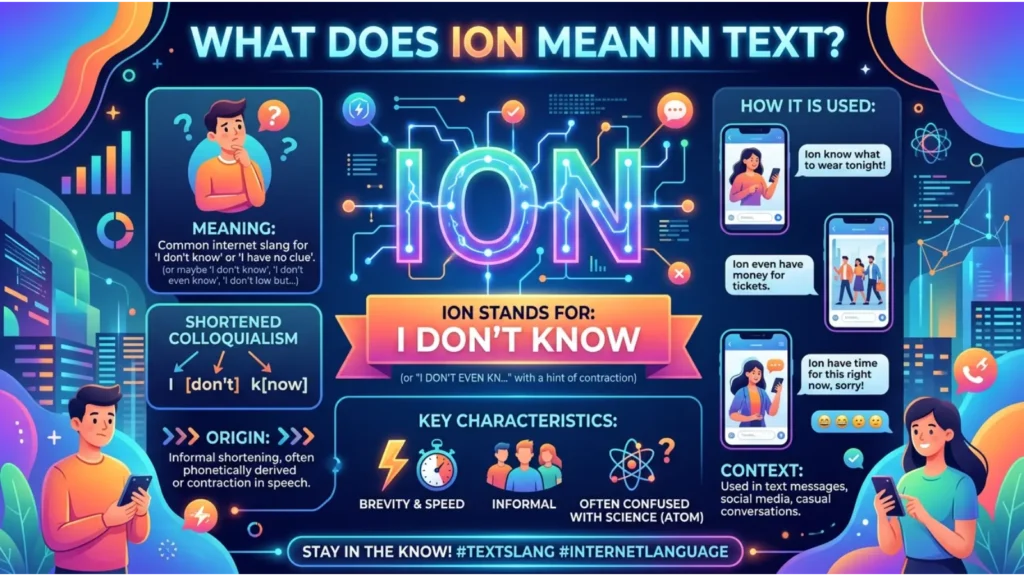
ION full form and definition
1. ION = “I don’t”
This is the most common modern slang meaning.
People remove the apostrophe and shorten “I don’t” into “ION” for quicker typing. It is especially common among younger users on:
- TikTok
- Snapchat
- Discord
- Twitter/X
- Gaming chats
Example
- “ION like that movie.”
- “ION care anymore.”
- “ION even know him.”
In these examples, ION replaces the words “I don’t.”
2. ION = “In Other News”
This meaning is used when someone changes the subject or introduces another topic.
Example
- “ION, did you hear about the new update?”
- “ION, school starts next week.”
Here, the speaker is moving the conversation to something else.
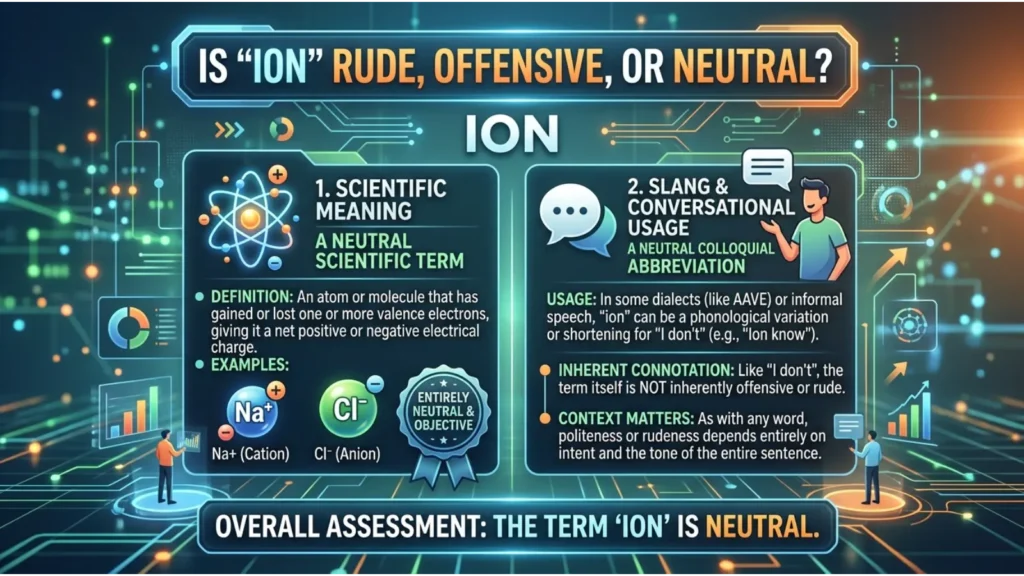
Is ION rude, offensive, or neutral?
ION is generally considered neutral slang. However, tone matters.
Neutral usage
- Casual texting
- Friendly conversations
- Online comments
- Social media captions
Potentially rude usage
Sometimes “ION care” or “ION wanna talk” can sound cold or dismissive.
Example
- “ION care what they think.”
This may appear rude depending on the situation and relationship between the people talking.
Where is ION commonly used?
ION is popular in digital communication, especially among younger internet users.
Common platforms
Social Media
- TikTok
- Facebook comments
- Twitter/X
Messaging Apps
- Snapchat
- Messenger
- Discord
Gaming Communities
Gamers often use abbreviations to type quickly during matches or live chats.
Memes and Online Humor
ION frequently appears in meme captions and reaction posts.
Why people use ION slang
People use slang abbreviations because they are:
- Faster to type
- Casual and trendy
- Easier during quick conversations
- Popular among internet communities
Using ION also creates a relaxed and informal tone in chats.
For example:
- “ION think that’s true.”
sounds more casual than: - “I don’t think that’s true.”
Real-life examples of ION usage
Friendly Tone
- “ION wanna miss the party tonight.”
- “ION think you should worry.”
Casual Tone
- “ION know what time it starts.”
- “ION even watch that show anymore.”
Argumentative Tone
- “ION care who started it.”
- “ION got time for drama.”
Gaming or Social Media Context
- “ION lagging today finally.”
- “ION think this update is good.”
“In Other News” Examples
- “ION, have you seen the latest movie?”
- “ION, my exams are next week.”
Origin and background of ION slang
The slang version of ION likely developed from fast texting culture and African American Vernacular English (AAVE), where spoken pronunciation sometimes sounds similar to “I don’t.”
Over time, internet users adopted the shortened spelling online.
As texting became more common, abbreviations like:
- ION
- IDK
- TBH
- NGL
- IMO
became part of internet language.
The “In Other News” version existed earlier in journalism and online forums before becoming common in chats.
ION meaning slang vs traditional meaning
The word “ion” also has a scientific meaning unrelated to texting slang.
Scientific Meaning
In science, an ion is an electrically charged atom or molecule.
Example
- Positive ion
- Negative ion
However, when written in lowercase or uppercase during texting, people usually mean the slang version.
Context helps identify the correct meaning.
Comparison with similar slang terms
| Slang Term | Meaning | Usage Style |
|---|---|---|
| ION | I don’t / In Other News | Casual texting |
| IDK | I don’t know | Common internet slang |
| IMO | In my opinion | Sharing opinions |
| TBH | To be honest | Honest statements |
| NGL | Not gonna lie | Casual honesty |
| FR | For real | Agreement or emphasis |
| SMH | Shaking my head | Disappointment |
Similar meanings and related slang
If you are interested in slang similar to ION, here are related terms often used in texting:
Similar slang for “I don’t”
- IDK = I don’t know
- IDC = I don’t care
- IKR = I know right
- IMK = In my knowledge
- NVM = Never mind
Similar phrases to “In Other News”
- BTW = By the way
- Anyway
- Speaking of that
- On another note
These abbreviations help conversations move faster online.
When should you avoid using ION?
Although ION is common online, it is not suitable everywhere.
Avoid using it in:
- Professional emails
- Job applications
- Academic writing
- Formal business communication
- Customer service messages
Using slang in formal situations may look unprofessional or unclear.
Instead of:
- “ION understand the issue.”
Use:
- “I don’t understand the issue.”
Polite alternatives to ION
If you want clearer or more professional communication, use full phrases.
| Slang | Polite Alternative |
|---|---|
| ION know | I don’t know |
| ION care | I’m not concerned |
| ION agree | I disagree |
| ION wanna | I do not want to |
These alternatives sound more respectful and professional.
Impact of slang in communication
Internet slang like ION has changed how people communicate online.
Positive effects
- Faster conversations
- Fun and expressive tone
- Builds online community culture
- Easier casual interaction
Negative effects
- Can confuse older users
- Sometimes unclear
- May appear rude
- Not appropriate in formal settings
Understanding context is important before using slang.
Is ION safe for social media?
Yes, ION is generally safe for social media use.
It is not considered dangerous, offensive, or harmful in most situations. However:
- Avoid using it aggressively
- Be careful with tone
- Know your audience
For example:
- “ION understand this trend.”
sounds harmless.
But:
- “ION care about your opinion.”
may sound rude.
🌍 Regional & Cultural Usage of “GNG”

“GNG” (Gang) is used differently across regions and cultures:
- 🇺🇸 US / UK: Mostly means close friends or crew (“my gang”) in street + social media slang
- 🇵🇰 / 🇮🇳 / South Asia:** Used in Instagram comments to show hype, friendship, or online bonding
- 🌍 Global Gen Z: Used as a universal internet slang for “my people / my circle”
- 🎮 Gaming communities: Refers to teammates or squad members
👉 Overall, “GNG” is now a global slang word for friendship, unity, and online community identity.
Examples of ION in conversations
Example 1 – Friendly Chat
Person A: Are you coming tonight?
Person B: ION know yet, maybe later.
Example 2 – Social Media Comment
“ION think this song is bad honestly.”
Example 3 – Gaming Chat
“ION got enough coins for that skin.”
Example 4 – Changing Topic
“ION, did you finish the assignment?”
Example 5 – Argumentative Tone
“ION care who was right.”
Frequently Asked Questions (FAQs)
What does ION stand for in texting?
ION usually stands for “I don’t.” It can also mean “In Other News.”
Is ION a bad word?
No, ION is not a bad or offensive word. It is generally neutral slang.
What does ION mean on Snapchat?
On Snapchat, ION most commonly means “I don’t.”
Example:
- “ION wanna go.”
Is ION formal slang?
No. ION is informal internet slang and should not be used in professional communication.
What is the difference between ION and IDK?
- ION = I don’t
- IDK = I don’t know
ION is broader and can fit more sentences.
Can ION mean “In Other News”?
Yes. In some contexts, ION means “In Other News” when introducing a new topic.
Conclusion
Understanding the ION meaning in text is important because the slang has multiple definitions depending on context. Most commonly, ION means “I don’t,” while in other situations it can mean “In Other News.”
The term is widely used on social media, texting apps, gaming chats, and casual conversations. Although it is generally harmless and neutral, users should still pay attention to tone and audience before using it.
Like many internet slang terms, ION helps people communicate faster and more casually online. However, it is best avoided in formal or professional communication where clear language matters more.
By learning the different meanings, examples, and related slang terms, you can better understand online conversations and use ION correctly in everyday texting.

Dave Barry is a slang and modern language writer who explains internet terms, texting abbreviations, and social media phrases in a simple way. He creates easy-to-understand guides on trending slang, online expressions, and digital communication. His writing helps readers quickly understand modern English used in chats and social platforms. At Meanifiy, Dave Barry shares fun and informative slang meaning content for everyday readers.