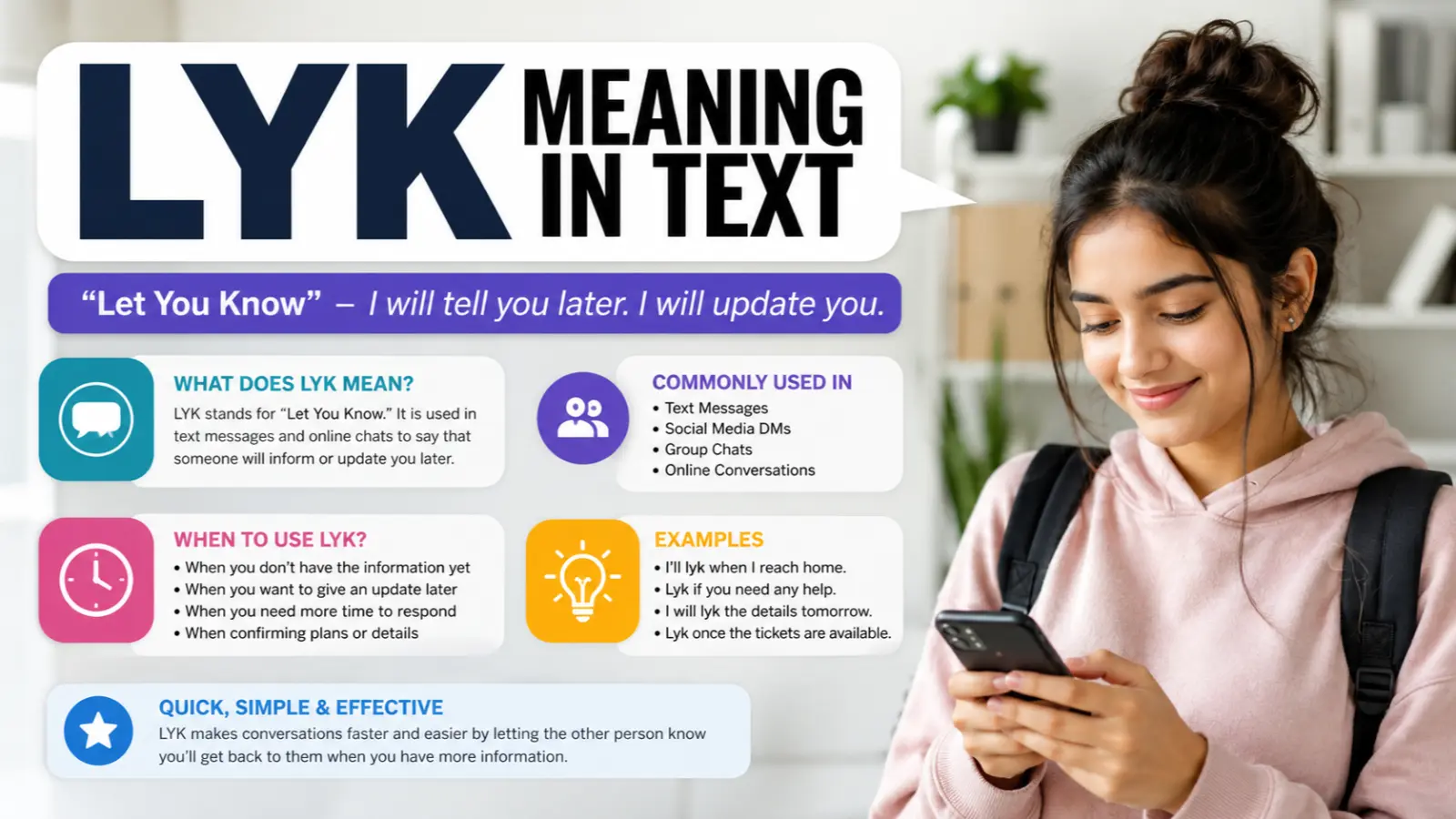
LYK meaning in text is most commonly “Let You Know.” It is a popular internet abbreviation used in texting, social media conversations, direct messages, and online chats to indicate that someone will provide information, updates, or a response later.
LYK meaning in text essentially communicates, “I will tell you later,” “I will update you,” or “I will inform you once I know more.” It is a convenient shorthand that helps people communicate quickly in digital conversations without typing the full phrase.
The abbreviation is widely recognized across messaging platforms and has become a standard part of modern online communication.
Quick Answer
Unlike traditional English vocabulary, LYK is not a standalone word found in most standard dictionaries. Instead, it belongs to the category of internet abbreviations and text slang.
Traditionally, the phrase “let you know” means to inform someone about information when it becomes available. In modern digital communication, users have shortened this phrase to LYK to save time and reduce typing effort.
Today, many people instantly recognize LYK as a promise of future communication. Rather than sounding formal, it conveys efficiency, convenience, and casual friendliness.
For example:
- Traditional phrase: “I will let you know once I receive the details.”
- Modern text version: “I’ll LYK when I get the details.”
The underlying meaning remains identical, but the delivery becomes faster and more conversational.
What Does LYK Mean in Text?
In text messages, LYK stands for “Let You Know.”
People use it when they:
- Need more information before responding
- Plan to provide an update later
- Are waiting for confirmation
- Want to postpone a decision temporarily
- Need time to check something
Examples include:
- “I’ll lyk when I get home.”
- “Lyk if you’re free tonight.”
- “I’ll lyk what the teacher says.”
- “Lyk once the tickets are available.”
The abbreviation can appear in several formats:
- LYK
- lyk
- Lyk
Lowercase “lyk” is especially common because most texting conversations prioritize speed over capitalization.
Users may also combine it with emojis:
- “I’ll lyk 😊”
- “Lyk asap 👍”
- “I’ll lyk later 👌”
The meaning remains unchanged regardless of capitalization or accompanying emojis.

Origin and Background of LYK
The phrase “let you know” has existed in English for centuries as a standard way of expressing future communication.
The abbreviation LYK emerged during the rise of digital communication in the late 1990s and early 2000s. Several technological developments contributed to its popularity:
- SMS text messaging
- Internet chat rooms
- Instant messaging platforms
- Early social networking sites
- Mobile phone communication
During the era of character-limited text messages, users began shortening common phrases to reduce typing effort. Similar abbreviations emerged during the same period:
- BRB (Be Right Back)
- IMO (In My Opinion)
- BTW (By The Way)
- IDK (I Don’t Know)
- TTYL (Talk To You Later)
LYK fit naturally into this growing ecosystem of shorthand communication because “let you know” was already one of the most frequently used conversational phrases.
As smartphones became widespread, the abbreviation remained popular despite improved keyboards and predictive text because users had become accustomed to concise messaging styles.
Contextual Applications: When to Use the Word
LYK is most effective in situations involving future updates or pending information.
Common scenarios include:
Making Plans
Someone may need to confirm availability before committing.
Example:
“I’ll lyk if I can make it tonight.”
Waiting for Information
When details are not yet available.
Example:
“I’ll lyk once the meeting ends.”
Professional Team Chats
In informal workplace messaging apps.
Example:
“I’ll lyk when the report is approved.”
Family Communication
Used to update relatives about schedules or plans.
Example:
“I’ll lyk when we arrive.”
Customer Service Conversations
Businesses sometimes use the phrase informally.
Example:
“We’ll lyk when your order ships.”
Group Chats
Friends frequently use it to coordinate events.
Example:
“Lyk if anyone wants to join.”
In all these situations, LYK acts as a placeholder for future communication.
Linguistic Boundaries: When NOT to Use the Word
Although LYK is useful, it is not appropriate in every communication setting.
Avoid using LYK in:
Formal Business Documents
Professional reports should use complete language.
Instead of:
“LYK when results come.”
Use:
“We will inform you when the results become available.”
Academic Writing
Research papers and assignments require formal vocabulary.
Legal Communication
Contracts and legal documents demand precision and complete wording.
Official Government Correspondence
Government communication generally avoids text slang.
First-Time Professional Interactions
Using LYK with someone you have never communicated with professionally may appear overly casual.
International Communication
Not everyone recognizes internet abbreviations, especially non-native English speakers.
Using the full phrase can prevent confusion.
Generational Differences in Usage (Gen Z vs. Millennials vs. Boomers)
Gen Z
Gen Z users frequently employ abbreviations like LYK.
They value:
- Speed
- Convenience
- Mobile-first communication
- Informal messaging styles
For this generation, LYK feels completely natural.
Millennials
Millennials helped popularize texting abbreviations during the early SMS era.
Most Millennials understand and regularly use LYK, particularly in personal communication.
Generation X
Many Gen X users recognize LYK but may prefer the complete phrase in certain contexts.
Usage varies depending on digital familiarity.
Baby Boomers
Boomers generally use fewer texting abbreviations.
While many understand the phrase “let you know,” some may not immediately recognize the acronym LYK without context.
This generational difference explains why younger internet users encounter LYK more frequently than older users.
Regional and Cultural Variations
The meaning of LYK remains remarkably consistent across English-speaking countries.
United States
LYK is commonly used in texting and social media.
United Kingdom
British users understand and employ the abbreviation similarly.
Canada
The acronym is widely recognized in digital conversations.
Australia and New Zealand
Users frequently use LYK in casual online communication.
Global English Communities
Because English serves as a global internet language, many non-native speakers also recognize LYK.
However, regional familiarity varies depending on exposure to English-language social media and messaging platforms.
In some countries, users may understand the phrase “let you know” but not immediately recognize the abbreviation.
Online Safety Context: Is It Safe for Kids?
Yes, LYK is generally considered completely safe for children and teenagers.
The abbreviation has:
- No adult meaning
- No offensive connotations
- No hidden sexual implications
- No violent associations
- No drug-related usage
It simply means “Let You Know.”
Parents, teachers, and educators can generally view LYK as harmless communication shorthand.
However, as with any internet slang, context should always be considered because surrounding conversation matters more than the abbreviation itself.
Safety Verdict:
LYK is child-safe, family-friendly, and appropriate for all age groups.
Exhaustive Real-Life Example Sentences
- I’ll lyk once I finish talking to the manager.
- Lyk if you need any help with the project.
- I’ll lyk when the concert tickets become available.
- Can you lyk whether you’re attending the meeting?
- We haven’t received confirmation yet, but we’ll lyk soon.
- Lyk when you get home safely.
- I’ll lyk what the doctor says after the appointment.
- Please lyk if there are any changes to the schedule.
Deconstructing the Examples: Contextual Breakdown
Example 1:
The speaker is awaiting information from a manager. LYK signals a future update rather than immediate knowledge.
Example 2:
The phrase functions as a request. The speaker encourages future communication if assistance becomes necessary.
Example 3:
The abbreviation indicates that information is currently unavailable but expected later.
Example 4:
Here, LYK serves as a request for confirmation. The listener is expected to provide a future response.
Example 5:
This example demonstrates group communication. The speaker promises to provide an update when confirmation arrives.
Example 6:
The phrase carries a caring tone. It requests notification once the recipient reaches home safely.
Example 7:
The update depends on future information from a doctor’s appointment.
Example 8:
This example appears in workplace or organizational communication where schedule changes may occur.
Real-Life Conversation Examples
Conversation 1
Person A: Are you coming to dinner tonight?
Person B: I’m not sure yet. I’ll lyk after work.
Person A: Sounds good. Just message me later.
Conversation 2
Person A: Did the teacher announce the exam date?
Person B: Not yet.
A: Okay, lyk when you find out.
B: Will do.
Conversation 3
Person A: Has the package arrived?
Person B: Not yet.
A: Alright, lyk when it gets there.
B: Definitely.
Semantic Variations: Synonyms and Comparative Analysis
| Expression | Meaning | Difference from LYK |
|---|---|---|
| Inform me | Provide information | More formal |
| Update me | Give new developments | Focuses on progress |
| Notify me | Officially alert someone | Professional tone |
| Keep me posted | Continue providing updates | Ongoing communication |
| Tell me later | Provide information later | More direct and conversational |
LYK is generally the shortest and most casual option among these alternatives.
Reversing the Meaning: Antonyms and Contrasting Terms
| Term | Contrast with LYK |
|---|---|
| Keep secret | Refuses to share information |
| Withhold information | Intentionally avoids updating |
| Conceal | Hides knowledge |
| Ignore | Gives no response at all |
| Stay silent | Provides no future communication |
These expressions oppose the central idea behind LYK, which is future information sharing.
Common Misconceptions and Misuses to Avoid
One common misconception is assuming LYK has hidden slang meanings. In most online contexts, it simply means “Let You Know.”
Another mistake involves using it in highly formal communication where complete phrases are expected.
Some users also confuse LYK with unrelated abbreviations because many internet acronyms share similar letter patterns.
To maintain accuracy:
- Use it primarily in casual communication.
- Recognize that it means future updates.
- Avoid assuming alternative meanings without context.
- Prefer the full phrase in formal environments.
Comprehensive Search Queries & Deep-Dive FAQs
What is the literal dictionary definition of LYK?
LYK is an abbreviation for “Let You Know,” meaning to inform someone or provide information at a later time.
How do you identify the hidden meaning or subtext of LYK in a conversation?
Usually there is no hidden meaning. The phrase simply indicates that someone intends to provide information, clarification, or an update later.
Is LYK considered formal vocabulary or informal text slang?
LYK is informal text slang commonly used in digital communication, texting, social media, and casual conversations.
How has the definition of LYK changed over the last few years?
The core meaning has remained stable. Its usage has expanded as texting, messaging apps, and social media became more central to everyday communication.
What does LYK mean on Snapchat, Instagram, and TikTok?
On Snapchat, Instagram, TikTok, and most social platforms, LYK almost always means “Let You Know” and signals that an update or response will be provided later.
Conclusion
Understanding LYK meaning in text helps decode a common piece of modern digital communication. While the abbreviation simply stands for “Let You Know,” its importance lies in how efficiently it communicates future updates, pending information, and ongoing conversations.
From text messages and group chats to workplace messaging platforms and social media interactions, LYK has become a practical shorthand used by millions of internet users. Its meaning remains consistent across generations, cultures, and online platforms, making it one of the more universally understood texting abbreviations.
Knowing when to use it—and when to choose the full phrase instead—allows communicators to match their language to the appropriate audience, setting, and level of formality.

Dave Barry is a slang and modern language writer who explains internet terms, texting abbreviations, and social media phrases in a simple way. He creates easy-to-understand guides on trending slang, online expressions, and digital communication. His writing helps readers quickly understand modern English used in chats and social platforms. At Meanifiy, Dave Barry shares fun and informative slang meaning content for everyday readers.