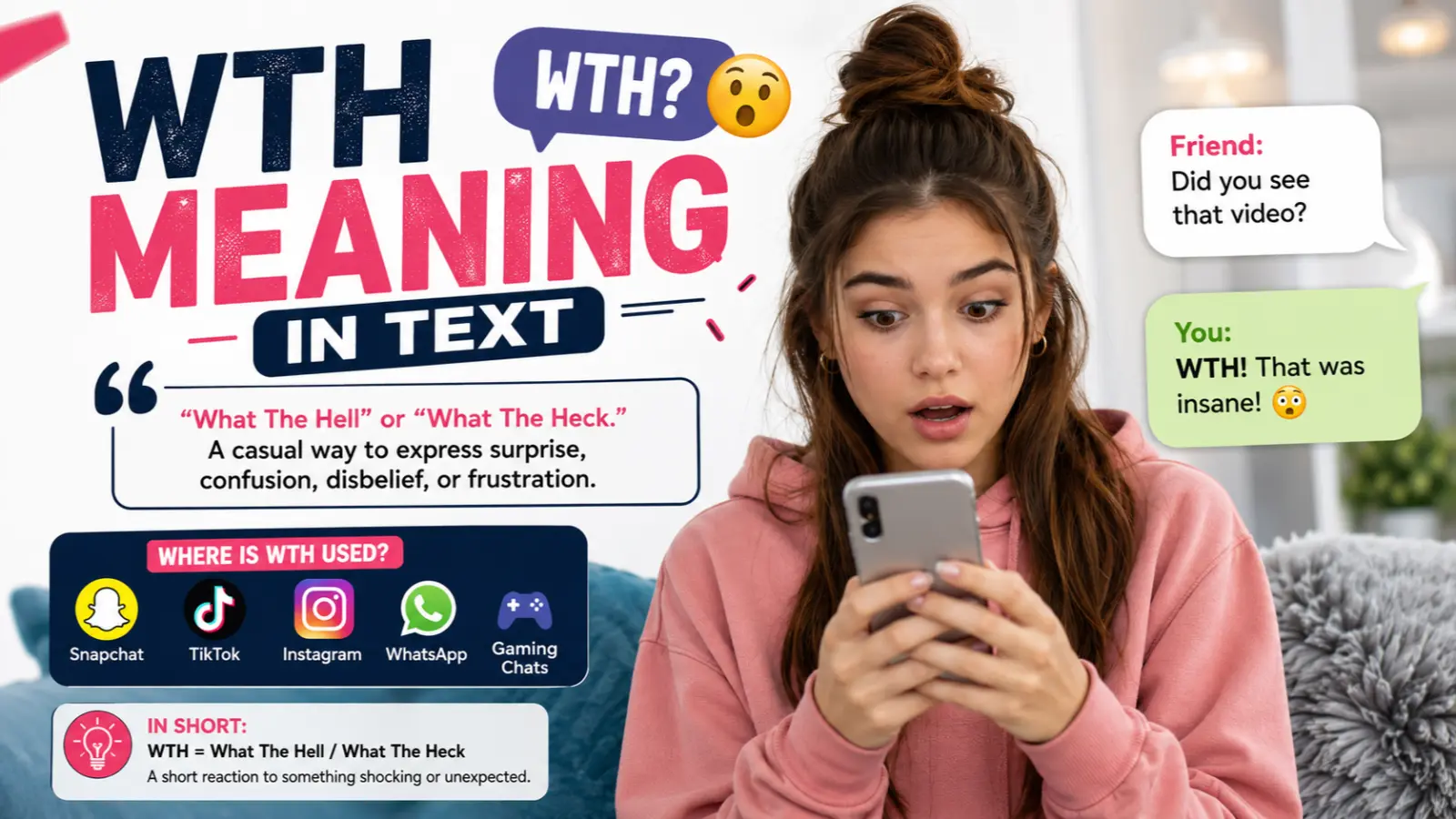
WTH meaning in text is most commonly interpreted as “What The Hell” or the softer alternative “What The Heck.” It is an internet slang abbreviation used to express surprise, confusion, disbelief, frustration, or shock during digital conversations.
WTH meaning in text has become widely recognized across messaging apps, social media platforms, online forums, and casual online communication because it allows users to quickly react to unexpected situations.
The phrase functions as an emotional response rather than a complete statement. Depending on context, it can sound humorous, annoyed, confused, or genuinely shocked.
Quick Answer:
Traditional Dictionary Definition vs. Modern Perception
Traditional dictionaries generally do not list WTH as a standalone vocabulary word because it is an abbreviation rather than a formal lexical item. Dictionaries that include internet slang usually define it as shorthand for “What The Hell” or “What The Heck.”
Modern internet users, however, often perceive WTH as a quick emotional reaction rather than a literal phrase. Many people type WTH automatically when something seems strange, unbelievable, or unexpected.
In everyday digital communication, the abbreviation carries less intensity than fully spelling out “What The Hell.”
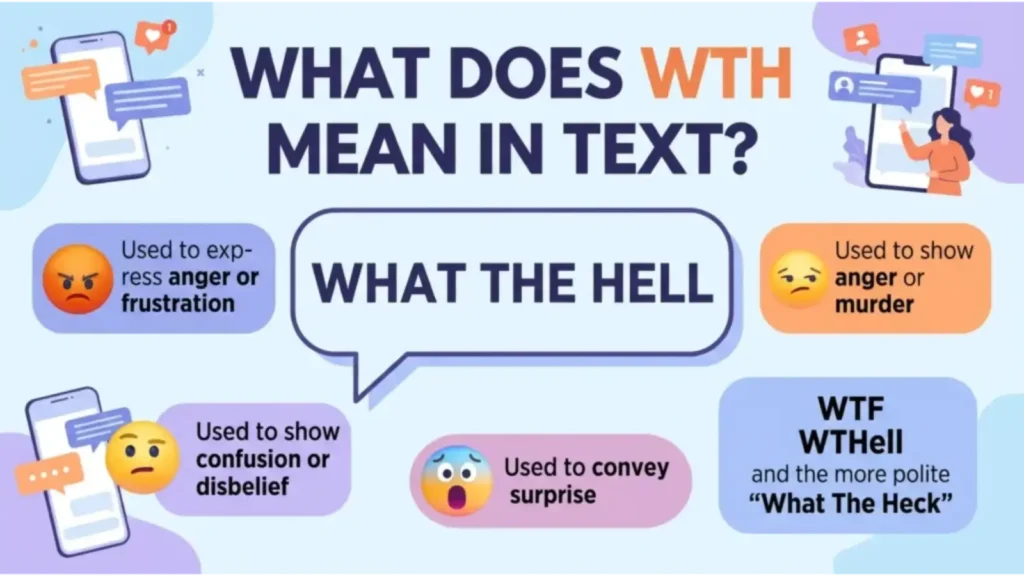
What Does WTH Mean in Text?
In texting, WTH is a reaction-based abbreviation used to communicate immediate emotion.
Common meanings include:
- Surprise
- Confusion
- Frustration
- Disbelief
- Mild anger
- Shock
Examples:
- “WTH just happened?”
- “WTH are you talking about?”
- “WTH 😂”
- “WTH?!”
The formatting often influences the emotional tone.
WTH
- Neutral surprise or confusion.
WTH?
- Seeking clarification.
- Stronger disbelief or shock.
Because texting lacks vocal cues, punctuation and emojis often help clarify the sender’s emotional intent.
Origin and Background of WTH
WTH emerged from the broader culture of internet abbreviations that became popular during the early days of online communication.
Its roots trace back to the full expression “What The Hell,” which has existed in English for generations as an exclamation of surprise or frustration. As internet users sought faster methods of communication, long phrases were shortened into abbreviations.
Several technological factors contributed to its growth:
- SMS character limits.
- Instant messaging platforms.
- Internet chat rooms.
- Online gaming communities.
- Social networking websites.
During the late 1990s and early 2000s, abbreviations such as LOL, BRB, OMG, and WTH became common online. WTH survived because it efficiently conveys a strong emotional reaction in only three letters.
Over time, users also began interpreting WTH as “What The Heck” when they wanted a cleaner and less aggressive version of the phrase. Today, both meanings coexist, and context determines which interpretation is intended.
Contextual Applications: When to Use the Word
WTH is appropriate in many informal situations where emotional reactions are expected.
Casual Text Conversations
Friends often use WTH when reacting to unexpected news.
Example:
“WTH, you got tickets already?”
Group Chats
The abbreviation helps express collective surprise or confusion.
Example:
“WTH happened while I was offline?”
Social Media Comments
Users frequently react to unusual posts, announcements, or videos.
Example:
“WTH did I just watch?”
Gaming Communities
Gamers often use WTH when unexpected events occur during gameplay.
Example:
“WTH was that move?”
Family Conversations
In relaxed family chats, WTH may be used casually if participants are comfortable with internet slang.
Example:
“WTH, dinner is ready already?”
The abbreviation works best when the environment is informal and conversational.
Linguistic Boundaries: When NOT to Use the Word
Although WTH is common online, there are situations where it may be inappropriate.
Professional Emails
Business communication generally requires formal language.
Avoid:
“WTH happened to the report?”
Use instead:
“Could you clarify the status of the report?”
Academic Writing
Formal essays and research papers should avoid internet slang.
Job Applications
Professional documents benefit from complete, polished language.
Communication with Authority Figures
Some teachers, supervisors, executives, or clients may view WTH as disrespectful.
Sensitive Conversations
When discussing serious topics involving grief, illness, or conflict, WTH can appear insensitive or dismissive.
Understanding audience expectations is essential before using internet abbreviations.
Generational Differences in Usage (Gen Z vs. Millennials vs. Boomers)
Gen Z
Gen Z frequently uses WTH in texts, social media posts, and group chats.
For younger users, the phrase often functions as a casual emotional reaction rather than an offensive expression.
Millennials
Millennials grew up during the rise of internet messaging and commonly understand WTH.
Many use it naturally in texting but may avoid it in professional contexts.
Generation X
Gen X generally recognizes WTH due to long-term exposure to digital communication.
Usage tends to be more selective than among younger generations.
Baby Boomers
Boomers often understand the phrase but may use it less frequently.
Some may prefer spelling out the complete expression or using alternative reactions.
The abbreviation is broadly understood across generations, but actual usage decreases with age.
Regional and Cultural Variations
WTH is primarily associated with English-speaking internet culture, but its interpretation varies across regions.
United States
American users commonly understand WTH as “What The Hell.”
The phrase often expresses disbelief, frustration, or surprise.
United Kingdom
British users recognize WTH but may use local expressions such as “What on earth?” more frequently.
Canada
Canadian users generally interpret WTH similarly to American users.
Australia
Australians understand the abbreviation and often use it in informal online communication.
International Internet Communities
Non-native English speakers frequently learn WTH through social media, gaming platforms, and entertainment content.
As a result, WTH has become part of global internet vocabulary, even among users who do not speak English as a first language.
Online Safety Context: Is It Safe for Kids?
Parents and educators often wonder whether WTH is appropriate for children.
Safety Assessment
WTH is generally considered a mild abbreviation.
Potential interpretations:
- What The Hell
- What The Heck
The “heck” version is widely viewed as child-friendly.
The “hell” version may be considered mildly inappropriate in some households, schools, or religious environments, but it is not generally classified as explicit profanity.
Hidden Meanings
There are no widely recognized dangerous, adult, or predatory meanings associated with WTH.
Verdict
WTH is generally safe for minors and is not considered harmful internet slang. Parents may still choose to discuss appropriate audience awareness and respectful communication.
Exhaustive Real-Life Example Sentences
- WTH happened to my phone overnight?
- WTH, I thought the meeting was tomorrow.
- WTH are those strange noises outside?
- My friend texted me, “WTH 😂 that was hilarious.”
- WTH, the website crashed again.
- WTH did I just read?
- WTH, you finished the entire project in one day?
- She replied with “WTH?” after seeing the surprising announcement.
Deconstructing the Examples: Contextual Breakdown
Example 1
The speaker expresses confusion regarding an unexpected situation. WTH functions as an immediate emotional reaction before the actual question.
Example 2
This example shows surprise caused by incorrect expectations. The abbreviation adds spontaneity and conversational authenticity.
Example 3
The speaker is reacting to uncertainty. WTH signals curiosity mixed with concern.
Example 4
The laughing emoji changes the emotional tone. Instead of frustration, WTH communicates amused disbelief.
Example 5
This usage reflects irritation about a recurring problem. The abbreviation softens the complaint while still expressing frustration.
Example 6
The speaker reacts to shocking or confusing information. WTH emphasizes disbelief.
Example 7
The phrase highlights astonishment regarding an impressive achievement. The emotional tone is positive rather than negative.
Example 8
Here WTH serves as a direct reaction to surprising news. The question mark reinforces confusion.
Real-Life Conversation Examples
Conversation 1
Person A: I accidentally deleted the entire folder.
Person B: WTH? Wasn’t it backed up?
Person A: Thankfully, yes.
Person B: Good, because that could have been disastrous.
Conversation 2
Person A: Guess what? I met my favorite actor today.
Person B: WTH, seriously?
A: Yes, and I got a photo too.
B: That’s incredible.
Conversation 3
Person A: The restaurant charged us twice.
Person B: WTH happened?
A: It was a payment system error.
B: You should contact customer support immediately.
Semantic Variations: Synonyms and Comparative Analysis
| Expression | Meaning | Emotional Strength | Difference from WTH |
|---|---|---|---|
| OMG | Oh My God | Moderate | Focuses more on surprise than confusion |
| WTF | What The F*** | Very Strong | Much more offensive and aggressive |
| Seriously? | Expression of disbelief | Mild | More polite and conversational |
| No Way | Surprise or disbelief | Mild | Usually expresses astonishment rather than frustration |
| What on Earth | Confusion or surprise | Moderate | More formal and less slang-oriented |
Reversing the Meaning: Antonyms and Contrasting Terms
1. Of Course
Represents certainty rather than confusion.
2. Obviously
Signals complete understanding instead of surprise.
3. Naturally
Suggests expected outcomes rather than unexpected events.
4. Certainly
Indicates confidence and clarity.
5. Understandable
Expresses comprehension where WTH would express confusion.
Common Misconceptions and Misuses to Avoid
Assuming It Always Means Anger
Many people think WTH automatically signals frustration. In reality, it often communicates surprise, amusement, or confusion.
Confusing WTH with WTF
Although similar, WTH is significantly milder and generally more socially acceptable.
Using It in Formal Communication
A common mistake is inserting WTH into professional messages where standard language is expected.
Ignoring Context
The abbreviation’s emotional meaning changes depending on punctuation, emojis, and surrounding conversation.
Assuming Everyone Understands It
While widely recognized, some people—particularly less internet-active users—may not immediately recognize the abbreviation.
Comprehensive Search Queries & Deep-Dive FAQs
What is the literal dictionary definition of WTH?
WTH is an abbreviation that typically stands for “What The Hell” or “What The Heck.” It functions as an exclamation expressing surprise, confusion, disbelief, or frustration. Most modern slang dictionaries classify it as informal internet shorthand.
How do you identify the hidden meaning or subtext of WTH in a conversation?
The surrounding message provides the strongest clues. If WTH appears alongside laughter emojis, it usually indicates amusement. If accompanied by question marks or complaints, it often reflects confusion or frustration.
Is WTH considered formal vocabulary or informal text slang?
WTH is overwhelmingly considered informal internet slang. It is suitable for texting, social media, and casual conversations but generally inappropriate for professional or academic communication.
How has the definition of WTH changed over the last few years?
The core meaning has remained stable. However, modern users increasingly interpret it as a lighter emotional reaction rather than a literal reference to “hell,” making it more socially acceptable in everyday online conversations.
What does WTH mean on Snapchat, Instagram, and TikTok?
On social media platforms, WTH typically means “What The Hell” or “What The Heck.” Users employ it as a quick reaction to surprising videos, unusual posts, unexpected news, or confusing content. The meaning remains largely consistent across platforms.
Final Summary and Linguistic Significance
WTH represents one of the internet’s most enduring reaction abbreviations. Whether interpreted as “What The Hell” or “What The Heck,” it allows users to communicate surprise, confusion, disbelief, frustration, and curiosity with remarkable efficiency. Its widespread adoption across texting, social media, gaming communities, and online discussions demonstrates how digital communication continues to favor concise emotional expression.
Understanding WTH goes beyond memorizing a definition. The abbreviation’s meaning depends heavily on context, audience, punctuation, and tone. Mastering these nuances helps users interpret online conversations more accurately and communicate more effectively in modern digital environments.

Spike Milligan is a slang meaning writer at Meanifiy.com who explains internet slang, texting abbreviations, and viral social media terms in simple language. He creates easy-to-read guides that help readers understand modern online communication and trending digital expressions. His writing style is fun, clear, and beginner-friendly. At Meanifiy.com, Spike shares engaging slang content that makes modern English easier for everyone.