Seeing “BDSM” in a text, TikTok comment, Reddit post, or dating profile can be confusing if you have never seen the term before. Unlike many texting abbreviations, BDSM is not usually casual slang. It is an acronym connected to a group of consensual relationship and sexual practices.
People often search for BDSM meaning in text because the term can appear without much explanation. Its meaning can also change slightly depending on the conversation.
Quick Answer:
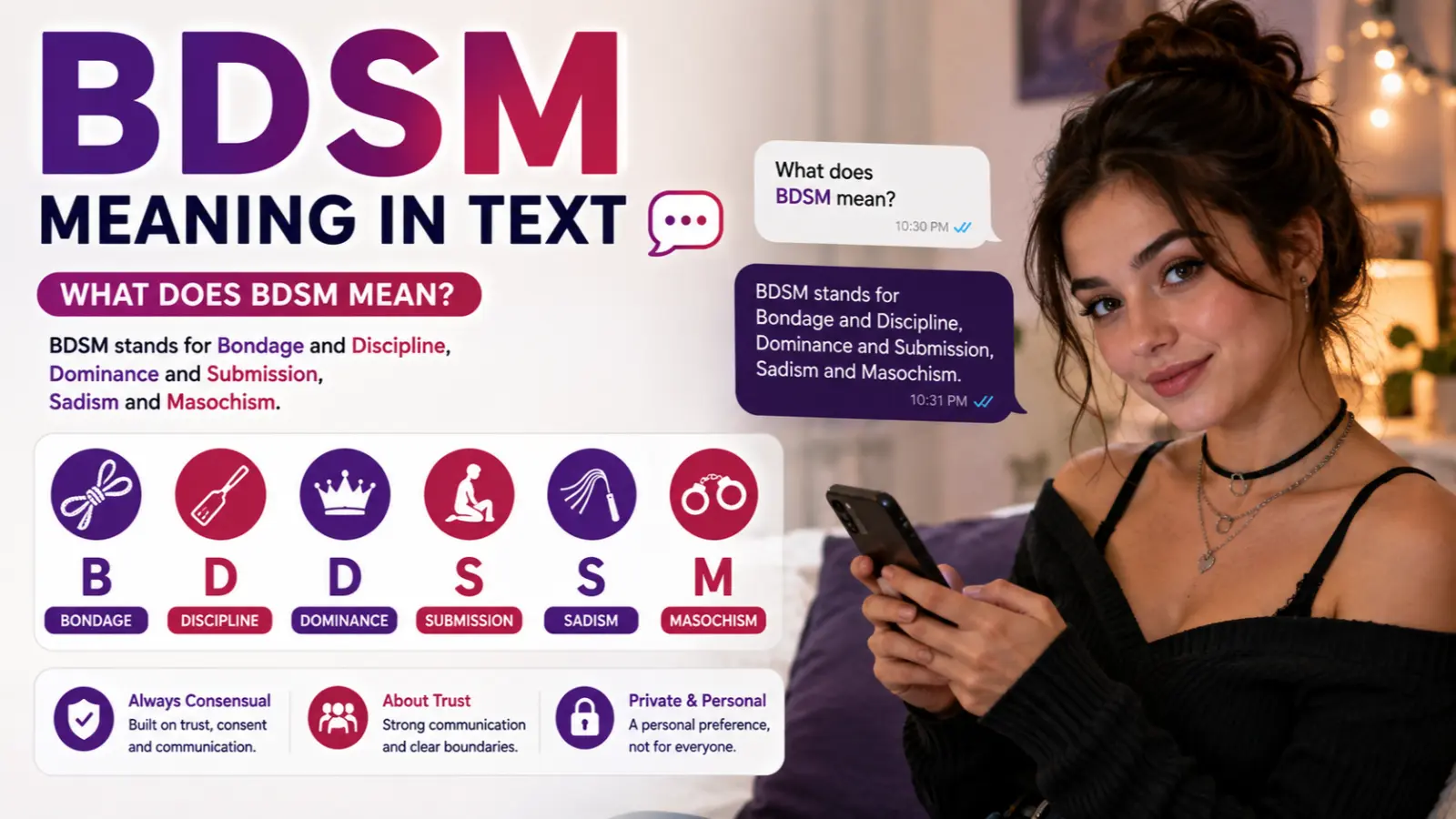
BDSM commonly stands for Bondage and Discipline, Dominance and Submission, Sadism and Masochism. Online, people usually use it when discussing consensual adult sexual interests, relationships, dating, or related communities. It is not normally used as a general texting abbreviation with an unrelated meaning.
What Does BDSM Meaning in Text?
In texting and online conversations, BDSM refers to a broad range of consensual adult practices involving themes such as restraint, power exchange, or the giving and receiving of physical sensation.
The acronym is commonly expanded as:
- B — Bondage
- D — Discipline
- D — Dominance
- S — Submission
- S — Sadism
- M — Masochism
The six terms are often grouped into three pairs: Bondage & Discipline, Dominance & Submission, and Sadism & Masochism.
Not everyone who uses the word BDSM is interested in every part of it. The term covers a broad spectrum of preferences and relationship dynamics.
Is BDSM always sexual?
No. BDSM is often discussed in a sexual or romantic context, but some people use BDSM-related dynamics without sexual activity.
For example, someone may discuss power exchange or consensual role-based dynamics as part of a relationship. Context matters.
BDSM Meaning in Different Online Contexts
In Text Messages
If someone mentions BDSM during a private conversation, dating discussion, or relationship chat, they are usually referring to BDSM practices or interests.
Example:
Alex: “What kind of relationships are you interested in?”
Sam: “I’m open-minded, and BDSM is something I’ve explored.”
Here, BDSM describes an adult relationship or personal interest.
On Dating Apps
BDSM can appear in profiles when someone wants to communicate that they are interested in BDSM-related relationships or are open to partners with similar interests.
The exact meaning depends on the person’s profile and conversation. You should not assume that someone who mentions BDSM wants every BDSM practice.
On TikTok, Reddit, or Social Media
People may use BDSM when discussing relationships, dating, sexuality, books, movies, online communities, or personal experiences.
Sometimes the word appears in educational discussions rather than as an invitation or personal disclosure.
In Online Communities
BDSM is also used as a general term for communities, education, discussions, and resources related to consensual BDSM practices.
Real Conversation Examples
Here are some non-explicit examples showing how the term can appear naturally:
Example 1 — Dating
A: “I saw BDSM on your profile. What does that mean for you?”
B: “It means I’m interested in consensual power dynamics. I’m happy to explain.”
Example 2 — Asking for clarification
A: “You mentioned BDSM earlier. Is that something you practice?”
B: “Yes, but only with clear boundaries and communication.”
Example 3 — Educational conversation
A: “I keep seeing BDSM online. What does it actually stand for?”
B: “It’s an acronym for several types of consensual adult practices and relationship dynamics.”
Example 4 — Setting boundaries
A: “Are you comfortable talking about BDSM?”
B: “Sure, but I’d rather keep the conversation educational.”
These examples show why context and consent matter when interpreting the term.
Is BDSM a Slang Word?
Not exactly.
BDSM is an acronym, not typical texting slang like “LOL,” “BRB,” or “IDK.”
People may use it casually in messages, but the term itself describes a specific area of adult relationships and sexuality.
So if someone texts:
“Do you know much about BDSM?”
They are usually asking about the subject itself, not using a secret abbreviation for another phrase.
Is BDSM Rude or Offensive?
The word BDSM is not automatically rude or offensive. It is a commonly used term for consensual adult practices and relationship dynamics.
However, it is a sensitive subject.
Using it in the wrong setting can make people uncomfortable. For example, bringing up BDSM in a workplace conversation, classroom discussion without relevant context, or an unexpected family group chat would usually be inappropriate.
A person’s comfort level also matters. Avoid assuming that someone wants to discuss their private interests simply because they used the term.
BDSM and Consent: Why Context Matters
One of the most important parts of understanding BDSM is consent.
BDSM refers to consensual activities and dynamics. Healthy BDSM discussions commonly involve:
- Clear agreement between adults
- Communication about boundaries
- Respect for limits
- The ability to stop an activity
- Attention to comfort and safety
- Mutual understanding of what has been agreed upon
The word BDSM should not be treated as another word for abuse or non-consensual behavior. Consent is a central distinction.
That also means you should not interpret the word as proof that someone wants a particular activity.
Common Misunderstandings About BDSM
“BDSM means one specific activity.”
Not necessarily. BDSM is an umbrella term covering several different interests and dynamics.
“Everyone interested in BDSM likes the same things.”
No. People have different preferences, boundaries, and levels of interest.
“BDSM always means a sexual conversation.”
Not always. The subject frequently appears in sexual or dating contexts, but it can also appear in educational, cultural, relationship, or community discussions.
“If someone says BDSM, they are inviting me to discuss sex.”
Not necessarily. Someone may simply be answering a question, describing a preference, or discussing the topic academically.
When Should You Avoid Using BDSM?
Avoid bringing up BDSM when the subject is unrelated or when you do not know whether the other person is comfortable discussing it.
It is especially wise to avoid unsolicited sexual conversations with strangers or people in professional settings.
At work, for example, use neutral language when discussing a relevant topic:
- “adult relationship dynamics”
- “consensual relationship practices”
- “BDSM-related topics”
If the subject is not relevant to the conversation, it is usually better not to introduce it.
BDSM vs. Similar Terms
| Term | Meaning | Main Difference |
|---|---|---|
| BDSM | Broad acronym covering several consensual practices and dynamics | Umbrella term |
| Bondage | Restriction or restraint as part of consensual activity | One part of BDSM |
| Dominance | A consensual power role | One part of BDSM |
| Submission | A consensual role involving power exchange | One part of BDSM |
| Kink | Broad term for unconventional sexual interests | Wider term that can include BDSM |
| Vanilla | Informal term for sexual activity without kink or BDSM elements | Often used as a contrast to kink |
These terms overlap, but they are not interchangeable.
Where You Are Most Likely to See BDSM
You may encounter BDSM in:
- Text messages
- Dating apps
- Reddit discussions
- TikTok or other social media posts
- Online relationship communities
- Adult educational content
- Books, movies, and discussions about sexuality
It is much less likely to function as ordinary workplace or everyday texting slang.
FAQs:
What does BDSM Meaning in Text?
BDSM usually stands for Bondage and Discipline, Dominance and Submission, Sadism and Masochism. In texts, it generally refers to consensual adult practices or relationship dynamics.
Is BDSM an acronym or slang?
BDSM is an acronym. Although people use it casually online, it is not typical texting slang.
BDSM Meaning in Text on a dating app?
On a dating app, BDSM usually indicates that someone is interested in, experienced with, or open to BDSM-related relationship dynamics. The person’s profile or conversation should provide the specific context.
Does BDSM always mean sex?
No. BDSM is often associated with adult sexual relationships, but some BDSM-related dynamics may be discussed or practiced outside sexual activity.
Is BDSM the same as kink?
Not exactly. Kink is a broader term for sexual interests outside conventional sexual practices. BDSM is one major category within the broader world of kink.
Is BDSM inappropriate to say in a text?
The word itself is not inherently inappropriate. However, the topic is sensitive and can be inappropriate if introduced without context or consent, especially in professional or unfamiliar settings.
Does BDSM have other common meanings in texting?
There is no widely recognized everyday texting meaning of BDSM that competes with its established adult-relationship meaning. Context can still affect how someone uses the acronym.
Key Takeaways
- BDSM is an acronym, not ordinary texting slang.
- It commonly means Bondage and Discipline, Dominance and Submission, Sadism and Masochism.
- It usually appears in adult dating, relationship, sexuality, or online community discussions.
- BDSM can include different interests, so the acronym does not describe one specific activity.
- Consent, communication, and personal boundaries are central to the concept.
- Context matters before assuming what someone means by mentioning BDSM.
Conclusion
When you see BDSM meaning in text, the safest interpretation is that the person is referring to BDSM and its related consensual adult practices or relationship dynamics.
The term can appear in dating profiles, private messages, social media discussions, and educational conversations. It is not normally a hidden texting phrase with a completely different meaning.
If someone uses BDSM in a conversation, look at the surrounding context rather than making assumptions about their personal preferences. A simple clarification such as “What do you mean by BDSM?” can prevent misunderstandings and keep the conversation respectful.

Tayyab Hassan is a Master’s graduate, content writer, and contributor at Meanifiy.com. He specializes in creating informative, reader-friendly content that simplifies language, meanings, and educational topics. With a commitment to accuracy and clarity, he helps readers understand complex concepts through engaging and accessible articles.