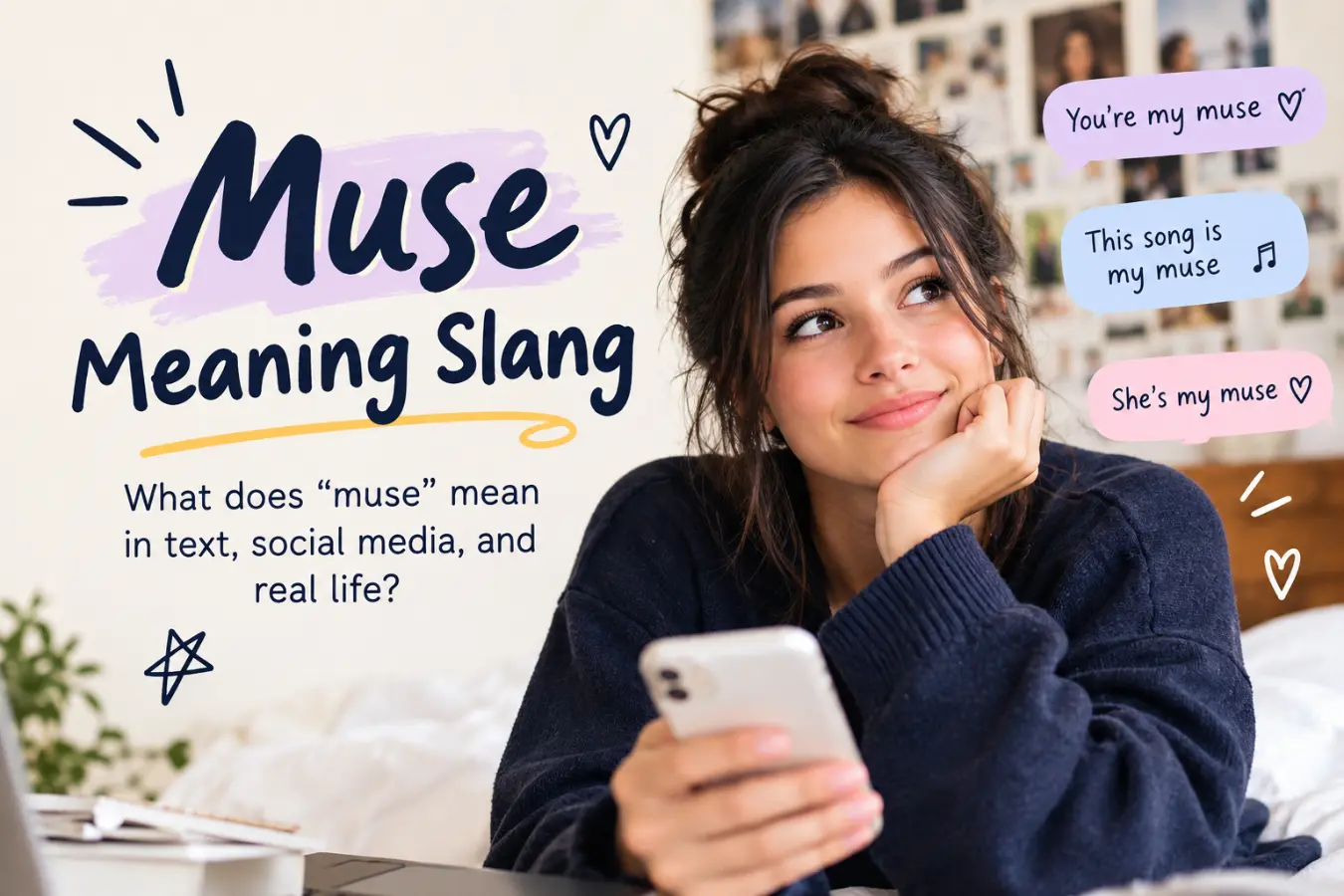
If you’re searching for muse meaning slang, you’re probably wondering what someone means when they call a person “my muse” in a text, comment, or social media post. In simple terms, a muse is someone or something that inspires you, especially creatively or emotionally.
The word muse is not a traditional texting abbreviation like “LOL” or “BRB.” Instead, people use it casually online to describe a person, song, style, place, character, or idea that sparks inspiration. The exact meaning can depend on the context and the relationship between the people using it.
Quick Answer:
In slang and online conversations, muse usually means a person or thing that inspires you strongly, especially creatively or emotionally. When someone says “you’re my muse,” they may be expressing admiration, attraction, or simply saying that you give them ideas and creative energy.
The meaning can change slightly with context. It may refer to a person, song, character, photo, style, place, or even a particular feeling.
What Does Muse Mean in Slang?
The simplest way to understand muse meaning slang is:
A muse is someone or something that inspires you.
For example:
- “She’s literally my muse.”
- “This song is my muse right now.”
- “You’ve become my muse.”
- “That outfit is giving muse energy.”
In these examples, muse does not necessarily mean a romantic partner. It can describe anyone or anything that sparks creativity or strong inspiration.
The modern online use is therefore more flexible than the traditional literary sense. A photographer might call someone their muse because they love photographing them. A writer might call a character their muse because the character inspires stories. Someone on TikTok might use muse simply to describe a person whose style or personality inspires their content.
Is “Muse” Actually Slang?
Not exactly.
Muse is a standard English word, not an abbreviation or slang term created by texting culture. Cambridge Dictionary defines the noun muse as a person or imagined force that gives someone ideas for writing, painting, or music. It also records Muse as the name for one of the nine goddesses associated with literature, art, and music in ancient Greek and Roman stories.
What people sometimes call “slang” is really a casual internet use of the traditional word.
Online conversations have made the word broader and more expressive. Instead of saying:
“You inspire my photography.”
Someone might simply say:
“You’re my muse.”
That shorter expression can sound more personal, artistic, or affectionate.
Muse Meaning on Social Media
On platforms such as Instagram, TikTok, Tumblr, and Discord, muse can appear in captions, comments, creative communities, fandom spaces, and roleplay discussions.
On Instagram
A person might call a model, friend, partner, or celebrity their muse because they inspire photographs or an aesthetic.
Example:
“My best friend is my muse for this entire photo series.”
Here, muse means creative inspiration.
On TikTok
TikTok users may use the word more casually to describe someone or something influencing their style, mood, or content.
Example:
“This song has been my muse all week.”
The speaker means that the song has been giving them inspiration or shaping their creative mood.
In Discord and fandom communities
Muse can have a more specific meaning in roleplay communities. A “muse” may refer to a character that someone writes or portrays in a roleplay setting. Some online communities also use expressions such as “main muse” for a person’s primary character.
What Does “You’re My Muse” Mean?
This phrase is usually a strong compliment.
When someone says:
“You’re my muse.”
they are saying that your presence, personality, appearance, ideas, or relationship inspires them in some way.
The exact tone depends on the relationship.
It could be:
Romantic:
“You’re my muse. I write better whenever I’m thinking about you.”
Creative:
“You’re my muse for this photography project.”
Friendly:
“My sister is basically my muse for all my fashion ideas.”
Playful:
“Pinterest is my muse at this point.”
So, don’t automatically assume that “my muse” means “my crush.” Context matters.
Real Conversation Examples
Here are some natural ways the word can appear in everyday online conversations.
Example 1 — Romantic
A: “Why did you write that poem?”
B: “Honestly? You’re my muse 😂”
Here, B is probably saying that A inspired the poem.
Example 2 — Creative
A: “Who inspired this painting?”
B: “My friend Maya. She’s been my muse lately.”
The meaning is artistic rather than necessarily romantic.
Example 3 — Social media
A: “Your new photos are amazing.”
B: “Thank you! This place was my muse.”
Here, the location inspired the photographs.
Example 4 — Casual texting
A: “Why are you suddenly obsessed with vintage outfits?”
B: “Idk, Audrey Hepburn became my muse 😭”
The speaker means that the celebrity’s style is inspiring them.
Can a Guy Be a Muse?
Absolutely.
Although muse has historically been associated with female figures in art and literature, modern usage does not require the muse to be a woman. A man, woman, friend, partner, celebrity, fictional character, or even an abstract idea can be someone’s muse.
For example:
“He became my muse for the whole album.”
This simply means that he inspired the music.
The same applies to:
“She’s my muse.”
The sentence tells you that she inspires the speaker, but it does not automatically tell you whether the relationship is romantic.
Can a Thing Be a Muse?
Yes.
A muse doesn’t have to be a person.
People can describe all kinds of things as their muse:
- A song
- A movie
- A fictional character
- A city
- Nature
- Fashion
- A photograph
- A memory
- A particular mood
- A personal experience
For example:
“The ocean was my muse for this painting.”
That means the ocean inspired the artwork.
This broader use fits the traditional idea of a muse as a source of creative inspiration.
Where Did the Word “Muse” Come From?
The word has a long history rather than a recent internet origin.
In ancient Greek mythology, the Muses were nine goddesses associated with different areas of artistic and intellectual activity. The traditional number and names of the nine Muses became established in ancient Greek literature, including the work of Hesiod.
Over time, muse also came to mean a person or force that inspires an artist.
That is the meaning that survives in modern English. Internet culture has simply made it more casual and expanded how people apply it.
There is also a separate verb muse, meaning to think about something carefully or deeply. For example:
“He mused about what to do next.”
That verb is not the same as calling someone “my muse.” Cambridge lists both meanings separately.
Muse vs. Inspiration
These words are very close, but they are not always used in exactly the same way.
Inspiration is the broader word. Anything that gives you an idea or motivates you can be an inspiration.
Muse often feels more personal or artistic.
Compare:
“This book inspired me.”
versus:
“This author is my muse.”
The second sentence suggests a more personal or ongoing source of creative inspiration.
Common Misunderstandings About “Muse”
“Muse” does not mean “girlfriend” or “boyfriend.”
Someone can be your muse without being your romantic partner.
It is not a texting abbreviation.
You don’t need to expand muse into a hidden phrase. It is a normal English word.
It does not always mean attraction.
Calling someone a muse can be romantic, but it can also be completely artistic or friendly.
It does not have to involve art.
Modern online usage can include fashion, content creation, personal style, motivation, and general aesthetic inspiration.
When Should You Use “Muse”?
Muse works well in casual, creative, and expressive conversations.
You can comfortably use it when talking about:
- Art
- Photography
- Writing
- Music
- Fashion
- Content creation
- Personal inspiration
- Aesthetic interests
For a formal workplace message, however, a clearer phrase may be better.
Instead of:
“Sarah is my muse for this project.”
you could write:
“Sarah’s work has been a major source of inspiration for this project.”
The second version is more direct and professional.
Key Takeaways
- Muse usually means a person or thing that inspires you.
- “You’re my muse” is generally a compliment.
- The word is not a texting abbreviation; it is an established English word.
- Online, muse can have creative, emotional, aesthetic, romantic, or playful meanings.
- A muse can be a person, song, character, place, idea, or experience.
- Context determines whether “muse” sounds romantic, artistic, or simply appreciative.
FAQS:
1. What does “muse” mean in texting?
In texting, muse usually means someone or something that inspires the speaker. “You’re my muse” can mean “you inspire me,” especially creatively or emotionally.
2. Does “my muse” mean my crush?
Not necessarily. It can have a romantic meaning, but someone can also be your muse because they inspire your art, writing, photography, fashion, or other creative work.
3. Is muse a Gen Z slang word?
The word itself is much older than Gen Z. However, younger internet users may use muse casually in captions, comments, fandoms, and conversations to describe inspiration or admiration.
4. What does “you’re my muse” mean from a guy?
It generally means that you inspire him in some way. Depending on the conversation, it can be romantic, creative, affectionate, or simply complimentary.
5. What does “she’s my muse” mean?
It means the speaker sees her as a source of inspiration. She could inspire their art, writing, photography, style, music, or even their general creativity.
6. Can a song be called a muse?
Yes. Someone may call a song their muse when it inspires their creativity, mood, writing, art, or another activity.
7. Is “muse” positive or negative?
Usually, it is positive. It normally communicates admiration or inspiration, although the tone can become playful or sarcastic depending on the context.
8. What is the difference between “muse” and “inspiration”?
They overlap heavily. Inspiration is the general idea, while muse often describes a particular person, thing, or source that repeatedly inspires someone’s creative work.
Conclusion
When you see muse meaning slang in a text, caption, or comment, the safest interpretation is “someone or something that inspires me.” The word can carry a romantic tone, but it doesn’t automatically mean a crush or partner.
Its internet use is best understood as a modern, flexible extension of the traditional meaning. Whether someone is talking about a person, song, character, outfit, or place, calling it a muse usually means it sparks ideas, creativity, emotion, or inspiration.

Tayyab Hassan is a Master’s graduate, content writer, and contributor at Meanifiy.com. He specializes in creating informative, reader-friendly content that simplifies language, meanings, and educational topics. With a commitment to accuracy and clarity, he helps readers understand complex concepts through engaging and accessible articles.