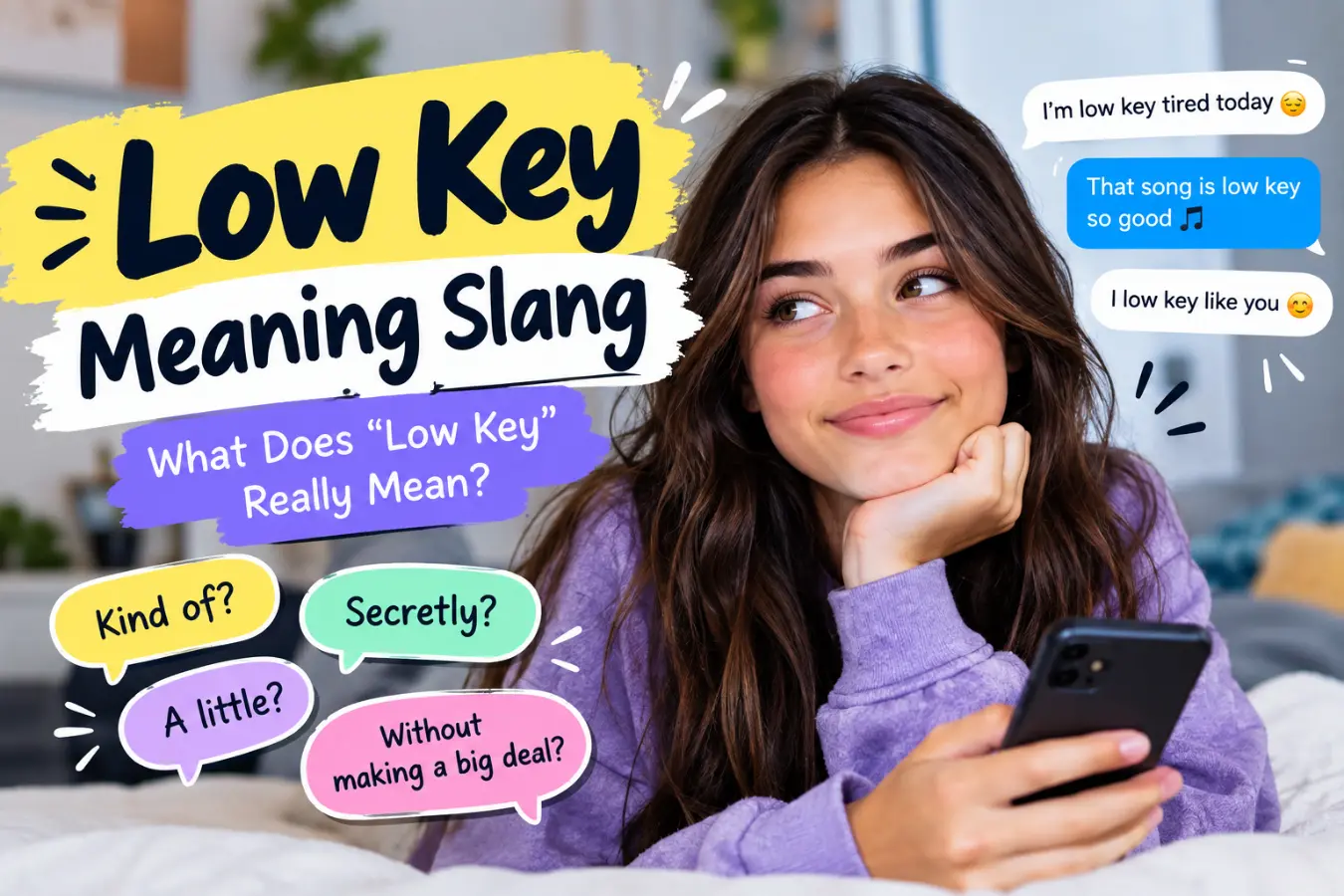
If someone texts “I low key love this song” or posts “low key tired today,” they usually are not talking about being physically low. In modern slang, “low key” often means somewhat, secretly, quietly, or without making a big deal about something.
People commonly use it in texting, social media posts, comments, and casual conversations. The exact meaning depends on the sentence and tone, which is why many people search for the low key meaning slang when they first come across it.
Quick Answer:
“Low key” is informal slang that usually means “a little,” “secretly,” “kind of,” or “without drawing attention to it.” For example, “I’m low key excited” means the person is excited but is not showing it strongly. It can have slightly different meanings depending on context.
What Does “Low Key” Mean in Slang?
In everyday online communication, low key is mainly used to soften a statement or express something privately.
For example:
- “I low key want pizza.” → I kind of want pizza.
- “She’s low key funny.” → She is actually or somewhat funny, perhaps more than people realize.
- “I’m low key nervous.” → I’m a little nervous, but I am not making a big deal about it.
- “He low key likes her.” → He probably likes her but is not openly showing it.
The phrase can therefore communicate both degree and privacy. You have to look at the surrounding sentence to understand which sense the speaker intends.
The Main Meanings of “Low Key”
1. “A Little” or “Kind of”
This is one of the most common uses in casual texting.
When someone says:
“I’m low key hungry.”
They usually mean:
“I’m kind of hungry.”
The speaker is not necessarily extremely hungry. Low key makes the statement sound less intense.
Example:
A: “Want to get something to eat?”
B: “Yeah, I’m low key starving.”
Here, “low key” can make the statement sound casual or understated, even though “starving” itself is strong.
2. “Secretly” or “Without Saying It Openly”
Sometimes low key suggests that someone has a feeling or opinion they are not openly announcing.
Example:
“I low key have a crush on him.”
This means the person has a crush but is keeping it somewhat private.
Another example:
“She low key wants to leave early.”
The speaker suggests that she wants to leave but may not be openly saying so.
3. “Quietly” or “Without Attention”
The phrase can also describe doing something without attracting attention.
“We’re keeping the party low key.”
Here, low key means relaxed, simple, and not highly public or extravagant.
This use is slightly different from slang such as “kind of.” The meaning comes from the broader idea of keeping something quiet or understated.
How “Low Key” Is Used in Texting
In texting, low key is often placed before an adjective, verb, or feeling.
Common patterns include:
Low key + adjective
- “I’m low key annoyed.”
- “That’s low key weird.”
- “This is low key amazing.”
Low key + verb
- “I low key miss school.”
- “I low key want to go.”
- “I low key forgot about it.”
Low key + opinion
- “Low key, that movie was good.”
- “Low key, I agree with you.”
Because texting is informal, people usually do not use the phrase according to strict grammar rules. The goal is to communicate a casual tone.
Real Conversation Examples
Example 1: Casual Opinion
Sam: “Did you like the new song?”
Alex: “Low key, yeah. It’s actually pretty good.”
Here, “low key” makes the agreement sound casual rather than enthusiastic.
Example 2: Hidden Feeling
Mia: “Do you like your new coworker?”
Sara: “I low key have a crush on him 😂”
Here, low key suggests that the crush is not being openly announced.
Example 3: Mild Emotion
Jake: “Are you nervous about tomorrow?”
Tom: “Low key 😭”
This means “Yes, a little” or “I’m secretly pretty nervous.”
Example 4: Social Media Comment
“Low key the best movie I’ve watched this year.”
The commenter is saying the movie is very good while using an intentionally casual or understated tone.
“Low Key” vs. “High Key”
Low key and high key are often used as opposites in informal online speech.
| Phrase | Common meaning | Example |
|---|---|---|
| Low key | secretly, somewhat, casually, or understated | “I low key like it.” |
| High key | openly, strongly, or very clearly | “I high key love it.” |
For example:
“I low key want to go.”
This sounds like a casual or somewhat hesitant admission.
“I high key want to go.”
This sounds much more direct and enthusiastic.
However, high key is less universal than low key, and people may use both phrases differently depending on their online community.
Where Is “Low Key” Used?
You can commonly encounter low key in informal digital communication, including:
- WhatsApp messages
- Instagram captions and comments
- TikTok comments
- Snapchat conversations
- Reddit discussions
- Discord chats
- Facebook posts and comments
- Casual workplace messaging
It is especially natural when people are expressing opinions, feelings, reactions, or personal preferences.
Is “Low Key” Rude?
Usually, no. “Low key” is generally casual rather than rude.
The main issue is formality. It may sound out of place in a formal report, academic paper, business proposal, or official email.
Instead of writing:
“I low key disagree with this proposal.”
in a formal workplace message, you could write:
“I have some concerns about this proposal.”
The professional version is clearer and more appropriate for formal communication.
Common Misunderstandings
“Low key” does not always mean “secretly”
This is one of the biggest points to remember.
“I low key love this song” can mean:
- “I secretly love this song.”
- “I actually really like this song.”
- “I kind of love this song.”
The exact shade of meaning depends on context.
It does not always mean the feeling is weak
Someone saying:
“I low key love you.”
may not mean their feelings are weak. The phrase can simply make the confession sound less dramatic, playful, or private.
“Low key” is not an acronym
Unlike terms such as BRB or IDK, low key is a phrase made from ordinary English words. It does not have a standard “full form.”
Where Did “Low Key” Come From?
The expression has roots in the older English phrase “low-key,” which describes something restrained, quiet, or not strongly emphasized.
Its modern slang use developed from this general idea of keeping something understated or not drawing attention to it. Online communication helped expand its use, especially among younger speakers.
The exact point when the modern slang sense became widespread is difficult to identify, so it is better not to assign the phrase to one specific person, platform, or event.
Similar Slang Terms
A few informal expressions overlap with low key, but they are not exact substitutes.
Kind of / kinda
Usually means “somewhat.”
“I kinda like it.”
Secretly
More directly suggests that something is being kept hidden.
“I secretly like it.”
Honestly
Signals that the speaker is giving a genuine opinion.
“Honestly, I like it.”
High key
Often works as an informal contrast to low key and suggests something is obvious, strong, or openly expressed.
Understanding these differences helps you avoid treating low key as if it always has one fixed definition.
Key Takeaways
- Low key is informal slang used in everyday communication.
- It can mean “kind of,” “somewhat,” “secretly,” or “without making a big deal.”
- The exact meaning depends on the sentence and context.
- It is common in texting, social media, comments, and online chats.
- Low key is usually casual, not offensive.
- Avoid it in highly formal writing when a clearer standard-English phrase would work better.
FAQS:
What does “low key” mean in texting?
In texting, low key usually means somewhat, secretly, casually, or without making something obvious. For example, “I low key miss you” can mean “I kind of miss you” or “I secretly miss you.”
What does “I low key like you” mean?
It usually means “I kind of like you” or “I like you but I’m not openly admitting it.” The exact meaning depends on the conversation and tone.
What does “low key” mean on TikTok?
On TikTok, low key is commonly used to make a reaction or opinion sound casual, understated, or slightly private. For example, “Low key this is the funniest video” means the person thinks the video is very funny but expresses it casually.
Is “low key” positive or negative?
It can be either. The phrase itself is neutral. For example, “low key amazing” is positive, while “low key annoying” is negative.
What is the opposite of “low key”?
High key is often used as an informal opposite. It generally suggests something is obvious, strong, or openly expressed.
Is “low key” one word?
In modern slang, it is normally written as two words: “low key.” The hyphenated form “low-key” also appears when it functions as an adjective in standard English, such as “a low-key event.”
Is “low key” formal English?
Not usually in its modern slang sense. It is best suited to casual conversations, texting, social media, and informal online communication.
Can “low key” mean “secretly”?
Yes. In some contexts, low key suggests that a feeling, opinion, or action is being kept private or not openly expressed. Context determines whether “secretly” is the best interpretation.
Conclusion
Low key is a flexible piece of modern slang that usually adds an understated or casual tone to what someone is saying. Depending on context, it can mean “kind of,” “somewhat,” “secretly,” or “without drawing attention.”
So if someone texts “I low key love this,” they are probably telling you they really like itjust in a relaxed, understated way.

Tayyab Hassan is a Master’s graduate, content writer, and contributor at Meanifiy.com. He specializes in creating informative, reader-friendly content that simplifies language, meanings, and educational topics. With a commitment to accuracy and clarity, he helps readers understand complex concepts through engaging and accessible articles.