If I see someone write “this song is a bop,” I usually understand it as a strong compliment. They are saying the song is catchy, enjoyable, or has a beat that makes them want to listen again.
But when I see “she’s a bop” in a social-media comment, the meaning can change completely. In that context, “bop” can be a derogatory label aimed at a person, usually suggesting that they are sexually promiscuous or post suggestive content online.
That difference is why I think the context matters more than the word itself. You may see “bop” in TikTok comments, Instagram posts, group chats, music discussions, and casual texting. The word is not an acronym, and it does not have just one fixed meaning.
Quick answer:
In everyday slang, “bop” most commonly describes a catchy, enjoyable song. When it is used about a person, especially in newer social-media slang, it can be an insulting and sexualized label, so I would avoid using it that way.
Quick Answer
Bop has two important slang meanings. The positive meaning is used for a great or catchy song: “That track is a bop.” A newer social-media use describes a person with a derogatory implication about their sexual behavior or online presentation.
So, if you are unsure what someone means, look at what “bop” is describing. A song, album, or track usually signals the positive meaning; a person can signal the more offensive meaning.
What Does “Bop” Mean in Slang?
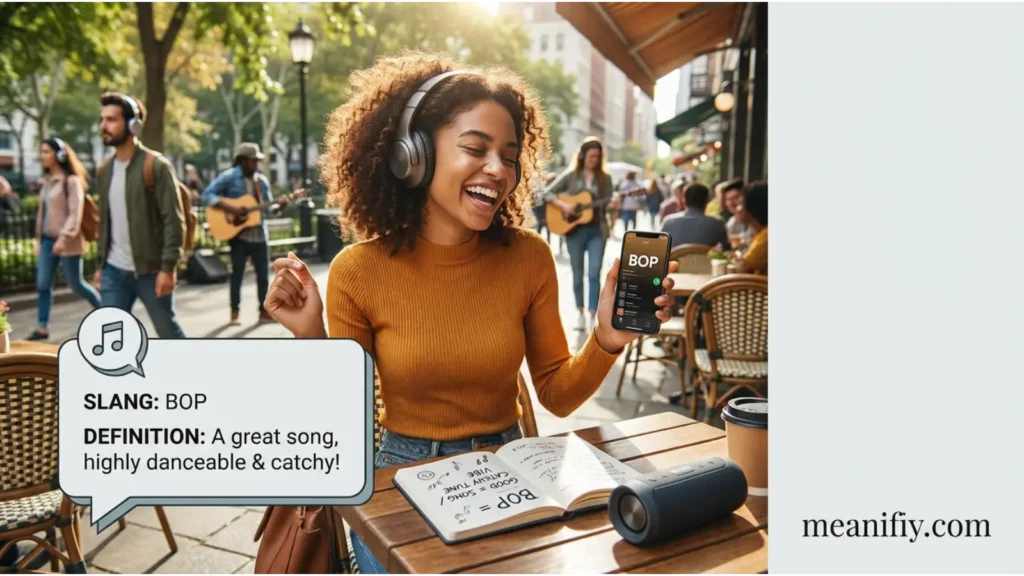
1. “Bop” means a catchy or really good song
This is the familiar, positive use of the word.
When someone says:
“This song is such a bop.”
They usually mean the song is catchy, fun, energetic, or enjoyable to listen to.
It does not necessarily mean the song belongs to one particular genre. A pop song, rap song, dance track, or another type of music can all be called a bop.
Examples:
- “I’ve had this song on repeat all morning. It’s a bop.”
- “The new single is actually a bop.”
- “That chorus is such a bop.”
This meaning is especially common in music conversations and social-media posts about songs.
2. “Bop” can be an insulting label for a person
There is another modern slang use that is much more sensitive.
When someone calls a person “a bop,” they may be making a derogatory claim about that person’s sexual behavior or suggesting that the person presents themselves in a sexually suggestive way online. The term is often aimed at girls or women and can function as a form of shaming or harassment.
For that reason, I would not treat this meaning as a harmless compliment.
Also, seeing someone called a “bop” does not mean the accusation is true. Online slang can be based on gossip, assumptions, or attempts to embarrass someone.
How Context Changes the Meaning
The easiest way for me to understand bop is to look at the noun around it.
| Example | Likely meaning |
| “This song is a bop.” | The song is catchy or enjoyable. |
| “That album has three bops.” | The album has several great songs. |
| “She’s a bop.” | A derogatory label about a person. |
| “They called her a bop.” | Someone used the insulting slang meaning. |
The difference is important because the exact same word can be completely harmless in one sentence and offensive in another.
Where You Might See “Bop”
You can encounter the positive meaning in:
- TikTok music posts
- Instagram captions and comments
- Snapchat conversations
- Group chats
- Music fandoms
- Casual texting
The person-directed meaning has also appeared heavily in social-media discussions, particularly TikTok-related slang. Search interest in that use increased during the 2023–2024 period.
Because slang changes quickly, not every person uses “bop” in exactly the same way. Context remains the safest guide.
Real Conversation Examples
Talking about music
A: “Have you heard the new song?”
B: “Yeah, it’s a bop. I’ve played it like five times.”
Here, bop = a really enjoyable song.
Recommending a song
A: “I need something upbeat for my playlist.”
B: “Try that new track. It’s a total bop.”
Again, the meaning is positive.
Seeing the word used about a person
A: “Why are people commenting ‘bop’ under her video?”
B: “They’re using it as an insult.”
Here, “bop” is not praising the video or music. It is being directed at a person.
What Does “Bop” Mean on TikTok?
On TikTok, “bop” can mean either a great song or a derogatory label for a person.
If the comment is connected to music, such as “this audio is a bop,” the positive meaning is likely.
If someone writes “she’s a bop” or uses the word to label a person, it can carry the newer insulting meaning. Current slang references describe this person-directed usage as offensive and often connected with sexual shaming.
This is one reason people who are unfamiliar with newer slang can misunderstand TikTok comments.
Is “Bop” a Compliment?
It depends on what you are talking about.
Calling a song a bop is normally positive.
Calling a person a bop can be insulting because of the sexualized meaning attached to the word.
So I would not assume that “bop” is always a compliment simply because you have seen it used positively in music conversations.
Is “Bop” an Acronym?
No. In modern slang, bop is generally treated as a slang word, not an acronym or texting abbreviation.
You do not need to expand it into a traditional “full form” when someone uses it to describe a song.
Some internet posts have proposed alternative expansions or backronyms, but those should not automatically be treated as the established meaning of the word.
Where Did “Bop” Come From?
The word has a much older history than its current social-media slang.
Bop has long been associated with music and dance. In particular, bebop, a style of jazz that developed in the 1940s, is connected to the word’s musical history. Later, “bop” became informal slang for music that is lively, catchy, or enjoyable.
The newer person-directed slang developed separately in internet culture. Its exact origin is difficult to establish with certainty, so I would be cautious about claims that present one specific explanation as the unquestionable origin. Contemporary references document the derogatory use becoming prominent online during the 2020s.
“Bop” vs. Similar Slang
Bop vs. Banger
Both can describe a very good song.
- Bop: usually emphasizes a catchy, enjoyable song.
- Banger: often suggests a particularly powerful, exciting, or high-energy track.
They can overlap, so someone might reasonably describe the same song as both.
Bop vs. Hit
A hit usually refers to a successful or popular song.
A bop is more casual and expresses someone’s personal enthusiasm for the song.
Bop vs. Good Song
“Good song” is neutral.
“Bop” is more expressive and conversational. It communicates enthusiasm rather than simply giving an evaluation.
Common Misunderstandings
“Bop always means a good song.”
Not necessarily. The music’s meaning is positive, but the person-directed slang can be insulting.
“Calling someone a bop means they are attractive.”
Not reliably. Some internet users may use slang loosely, but the established newer person-directed use can carry a derogatory sexual implication.
“Bop is just another word for a girl.”
No. Bop is not a neutral synonym for “girl.” When it is used about a girl or woman, it can carry a judgmental meaning.
“If someone calls me a bop, that proves something about me.”
No. It is simply a label someone has used. It does not establish that the claim behind the label is true.
When Should You Avoid Using “Bop”?
I would avoid using bop to label another person, especially in a school, workplace, or public setting.
The person-directed meaning can be insulting and can contribute to sexual shaming or online harassment.
If you are talking about music, however, “That song is a bop” is a normal casual expression.
If you need a neutral alternative when talking about a person, simply describe what you actually mean—for example, “fun,” “confident,” “talented,” or “stylish.”
Key Takeaways
- “Bop” commonly means a catchy, enjoyable song.
- “That song is a bop” is normally positive.
- When used about a person, “bop” can be a derogatory sexualized label.
- Context determines which meaning someone intends.
- The word is slang, not a standard acronym.
- If you are unsure about the meaning, look at what the word is describing.
FAQs:
What does “bop” mean in texting?
In texting, bop can mean a great or catchy song, especially when someone is discussing music. If it is used to describe a person, it can have the newer derogatory meaning.
What does “bop” mean on TikTok?
On TikTok, bop can describe a catchy song or, in person-directed comments, be used as an insulting label connected to sexual behavior or suggestive online presentation. Context is essential.
Is calling a song a “bop” a compliment?
Yes. “This song is a bop” is normally a positive way to say that the song is catchy, fun, or enjoyable.
Is “bop” an insult?
It can be. When it is directed at a person, particularly a girl or woman, it can carry an insulting and sexualized meaning.
Does “bop” mean “banger”?
They are similar when talking about music, but they are not identical. Both can praise a song, while “banger” often emphasizes a song’s high energy or impact.
What does “she’s a bop” mean?
In current social-media slang, “she’s a bop” can be a derogatory statement suggesting that the person is sexually promiscuous or presents herself in a sexually suggestive way online. Because it can be insulting, it is better not to use the expression casually.
Is “bop” a bad word?
Not always. “Bop” has a harmless, positive use for music, but its person-directed slang meaning can be offensive.
Can guys be called a “bop”?
The newer insulting slang is most commonly directed toward girls and women, but slang users can apply labels differently. The important point is that when “bop” targets a person, it may be derogatory regardless of gender.
Conclusion
The meaning of “bop” in slang depends almost entirely on context. If someone says “this song is a bop,” they are almost certainly giving the song a positive review and saying it is catchy or enjoyable.
The situation changes when bop is used as a label for a person. In newer social-media slang, that usage can be insulting and sexually judgmental, particularly toward girls and women.
So when I see “bop” online, I look at what it describes first. If it describes a song, it is usually praised. If it describes a person, I treat it carefully because the meaning may be offensive.

Tayyab Hassan is a Master’s graduate, content writer, and contributor at Meanifiy.com. He specializes in creating informative, reader-friendly content that simplifies language, meanings, and educational topics. With a commitment to accuracy and clarity, he helps readers understand complex concepts through engaging and accessible articles.