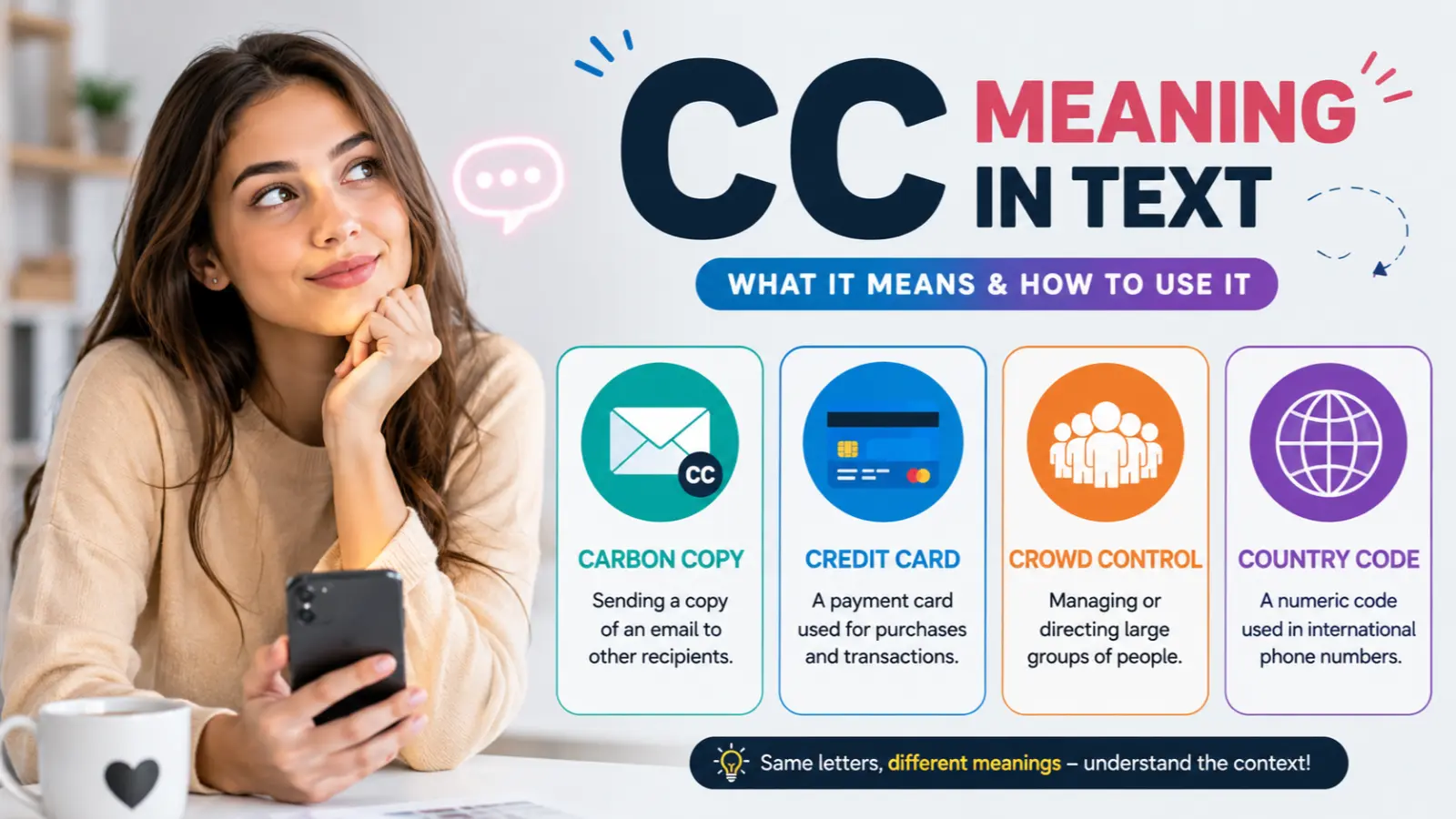
You may have seen someone write “CC me”, “What’s your CC?”, or simply “CC” in a message and wondered what they meant.
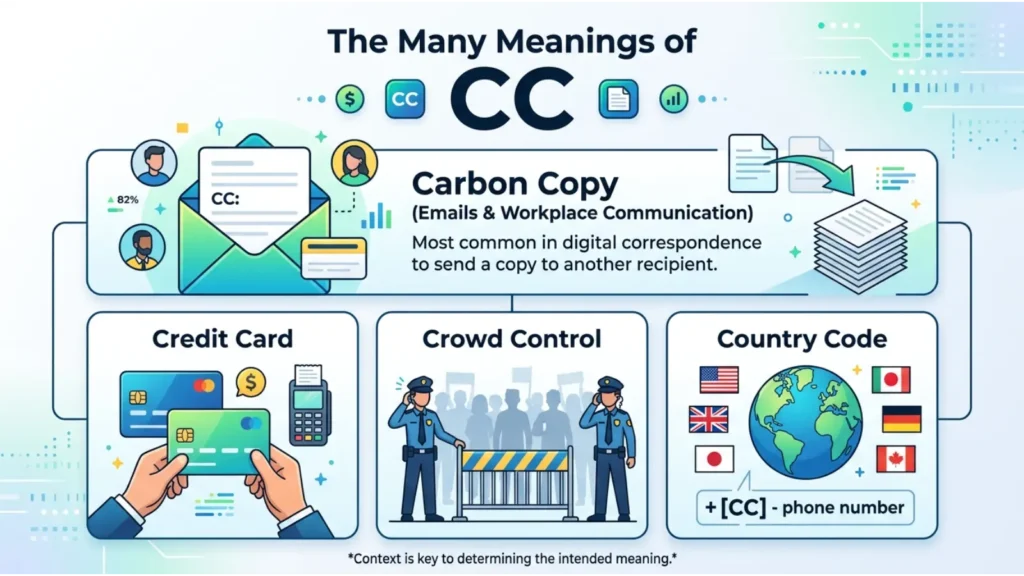
The answer depends on the conversation. CC is a multiple-meaning acronym that appears in texting, emails, workplaces, gaming, and everyday online communication. While many people associate it with Carbon Copy in email, it can also mean Credit Card, Crowd Control, or Country Code in different situations.
Understanding the context makes it easy to know which meaning is intended.
Quick Answer
CC most commonly means Carbon Copy in emails and workplace communication. However, it can also stand for Credit Card, Crowd Control, or Country Code, depending on the topic. The surrounding conversation usually makes the meaning clear.
What Does CC Meaning in text?
CC is an acronym with several well-known meanings. Unlike many internet abbreviations, it isn’t limited to texting.
Here are the most common definitions, ranked by everyday use.
| Meaning | Where You’ll See It | Commonness |
| Carbon Copy | Email, work, school | ⭐⭐⭐⭐⭐ |
| Credit Card | Shopping, banking, texting | ⭐⭐⭐⭐⭐ |
| Crowd Control | Gaming, sports, security | ⭐⭐⭐ |
| Country Code | International phone numbers, websites | ⭐⭐⭐ |
1. CC = Carbon Copy (Most Common)
This is the original and most widely recognized meaning.
In email, CC (Carbon Copy) lets you send a copy of your message to additional people without making them the primary recipient.
People often say:
- “Please CC me.”
- “I forgot to CC my manager.”
- “Can you CC the whole team?”
Example
Sarah: Can you send the meeting notes?
James: Sure. I’ll CC everyone in the department.
Why It’s Used
- Keeps others informed
- Shares updates
- Maintains transparency
- Includes managers or coworkers in conversations
2. CC = Credit Card
In texting, shopping, and banking conversations, CC often means Credit Card.
Example
Friend: How did you pay?
You: I used my CC.
Another example:
Alex: My CC expired yesterday.
Taylor: Time to request a new one.
This meaning is especially common when discussing:
- Online shopping
- Payments
- Banking
- Travel bookings
- Subscription services
3. CC = Crowd Control
Gamers and sports fans often use CC to mean Crowd Control.
In gaming, Crowd Control refers to abilities that temporarily stop or limit an opponent’s actions.
Examples include:
- Stuns
- Freezes
- Roots
- Silences
- Slows
Gaming Example
Player 1: We lost because nobody used CC.
Player 2: I’ll switch to a character with better crowd control.
Popular in games like:
- League of Legends
- World of Warcraft
- Dota 2
- Mobile Legends
- MMORPGs
4. CC = Country Code
When discussing international communication, CC can mean Country Code.
Examples include:
- +1 (United States/Canada)
- +44 (United Kingdom)
- +92 (Pakistan)
- +61 (Australia)
Example
Support Agent: Please include your CC before entering your phone number.
Here, CC refers to the international dialing code.
Where Is CC Commonly Used?
Because CC has several meanings, you’ll find it across different platforms.
| Platform | Typical Meaning |
| Carbon Copy | |
| Workplace Chat | Carbon Copy |
| Credit Card or Carbon Copy | |
| Credit Card | |
| Any meaning depending on the discussion | |
| Discord | Crowd Control (gaming) |
| Gaming Chats | Crowd Control |
| Banking Apps | Credit Card |
Real Conversation Examples
Example 1 – Office
Emma: Can you send the report?
David: Yes, I’ll CC the director.
Example 2 – Online Shopping
Mia: Did your payment go through?
Noah: Yes, I paid with my CC.
Example 3 – Gaming
Player A: Their tank has too much CC.
Player B: Stay back until the stun ends.
Example 4 – International Phone Number
Agent: Don’t forget your CC.
Customer: I’ll add +92 before my number.
Example 5 – School Project
Student: Should I CC our teacher?
Partner: Yes, so they receive a copy too.
Meaning in Different Contexts
In Text Messages
CC usually means Credit Card, especially in conversations about payments.
Example:
“I forgot my CC at home.”
In Emails
CC almost always means Carbon Copy.
Example:
“Please CC the finance department.”
In Gaming
CC means Crowd Control.
Example:
“Our team needs more CC.”
At Work
Employees commonly use CC when discussing emails.
Examples:
- “CC HR.”
- “Don’t forget to CC your supervisor.”
Origin of CC
Carbon Copy
The term dates back to the days of typewriters. People placed carbon paper between sheets to create duplicate copies while typing. The copied version became known as a carbon copy, which later inspired the CC field in email.
Credit Card
This abbreviation developed naturally as a shorter way to refer to a credit card in banking and everyday conversations.
Crowd Control
The gaming community popularized this abbreviation as multiplayer games introduced abilities that could stun, freeze, or disable opponents.
Country Code
Telecommunications adopted the abbreviation to identify international dialing prefixes.
Similar Terms
| Term | Meaning | Difference |
| BCC | Blind Carbon Copy | Other recipients cannot see who is BCC’d. |
| CC | Carbon Copy | Everyone can see CC recipients. |
| Debit Card | Bank card | Use your own money instead of borrowed credit. |
| Area Code | Regional phone code | Different from a country’s international code. |
Common Misunderstandings
Many people assume CC always means Carbon Copy.
That’s not true.
For example:
“My CC was declined.”
This clearly refers to a Credit Card, not an email.
Likewise:
“We need more CC.”
In a gaming discussion, this almost certainly means Crowd Control.
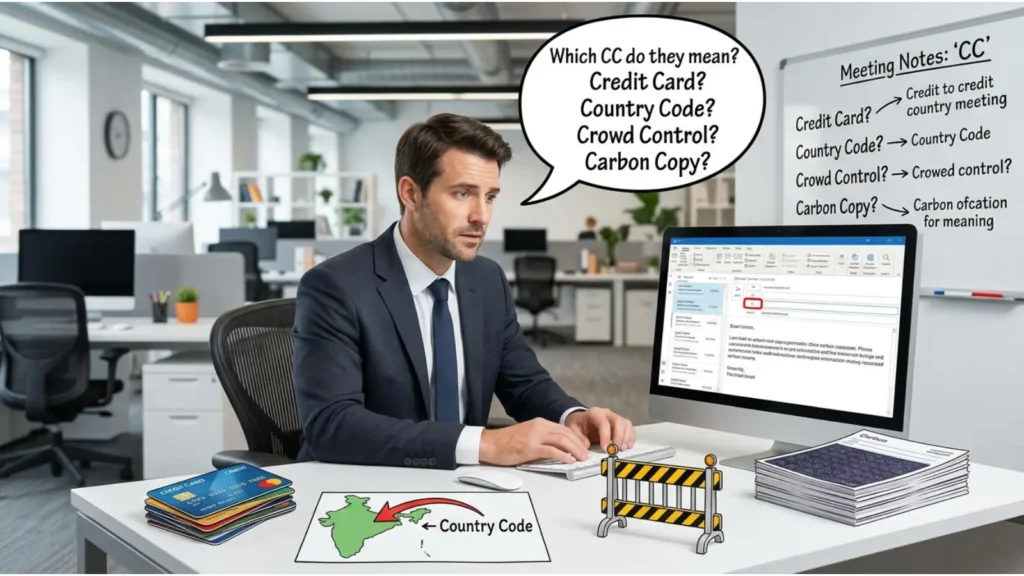
Always use the surrounding conversation to determine the correct meaning.
When Should You Avoid Using “CC”?
Using CC is perfectly acceptable in casual conversations and professional settings when the meaning is obvious.
However, avoid abbreviating it when:
- Writing legal documents
- Creating formal reports
- Speaking with people unfamiliar with the abbreviation
- Discussing financial matters where “Credit Card” should be written in full for clarity
Writing the full phrase helps prevent misunderstandings.
Key Takeaways
- CC has several common meanings.
- Carbon Copy is the most common meaning in emails.
- Credit Cards are common in banking and shopping conversations.
- Crowd Control is widely used in gaming.
- Country Code appears in international phone numbers.
- The surrounding context tells you which meaning is intended.
Frequently Asked Questions
What does CC meaning in a text message?
It usually means Credit Card, although it can also mean Carbon Copy if the conversation is about email.
Does CC always mean Carbon Copy?
No. While Carbon Copy is the most common definition, CC can also mean Credit Card, Crowd Control, or Country Code.
What does “CC me” mean?
It means to include someone as a Carbon Copy recipient when sending an email.
What does CC mean in gaming?
In gaming, CC stands for Crowd Control, which includes abilities that stun, freeze, slow, or disable opponents.
Is CC formal or informal?
It depends on the meaning. Carbon Copy is standard in professional emails, while Credit Card and Crowd Control are common abbreviations in everyday communication.
What is the difference between CC and BCC?
CC recipients are visible to everyone receiving the email. BCC recipients are hidden from other recipients.
Can CC have different meanings in the same conversation?
Yes, but it’s uncommon. The topic of the conversation usually makes the intended meaning obvious.
Conclusion
CC is a versatile acronym with several widely accepted meanings. In professional communication, it most often stands for Carbon Copy, while in financial conversations it usually means Credit Card. Gamers recognize it as Crowd Control, and people dealing with international phone numbers know it as Country Code.
Whenever you come across CC, don’t focus only on the letters—look at the context. A quick glance at the surrounding conversation will usually reveal the correct meaning, helping you understand and use the abbreviation with confidence.

Tayyab Hassan is a Master’s graduate, content writer, and contributor at Meanifiy.com. He specializes in creating informative, reader-friendly content that simplifies language, meanings, and educational topics. With a commitment to accuracy and clarity, he helps readers understand complex concepts through engaging and accessible articles.