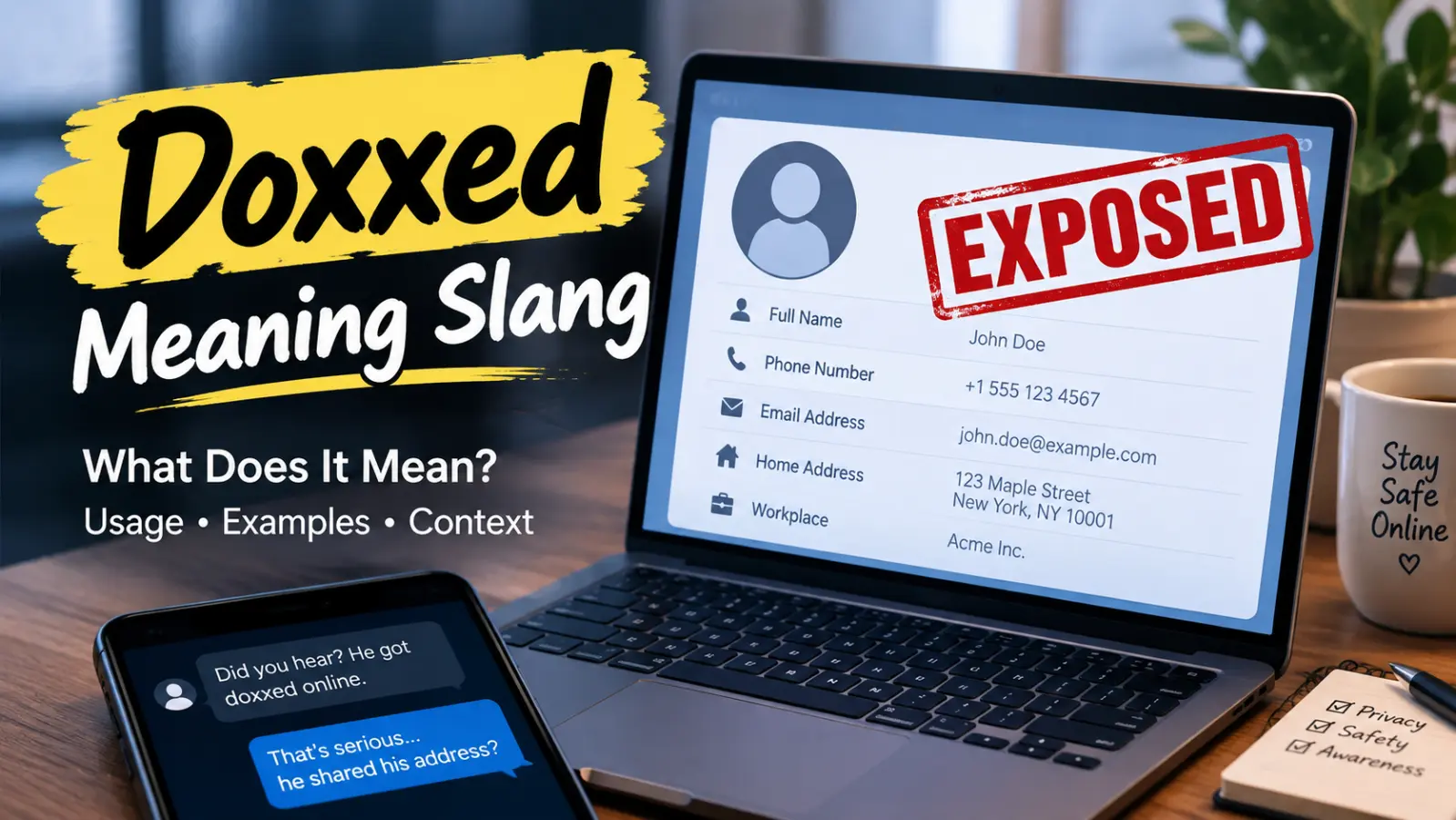
If you have seen someone say “I got doxxed” or “Don’t dox me,” you may wonder what the phrase means. The doxxed meaning slang refers to having someone’s private or identifying information exposed publicly online, usually without their permission.
The term appears in social media discussions, gaming communities, online arguments, and conversations about internet privacy.
People may use “doxxed” seriously when discussing a real privacy incident. It can also appear jokingly when someone reveals a friend’s personal detail. Context matters because the word normally refers to information that can identify or locate a person.
Quick Answer:
“Doxxed” is internet slang for having someone’s private or identifying information publicly exposed without their permission. It can refer to details such as a real name, address, phone number, or workplace. The word is commonly used in online communities, social media, gaming, and discussions about privacy.
What Does Doxxed Mean in Slang?
Doxxed means that someone’s personal or identifying information has been revealed online, generally without their consent.
The information can vary depending on the situation. It may include someone’s real name, home address, phone number, email address, workplace, or other details that connect an online identity to a real person. Oxford describes dox as an informal verb meaning to reveal information about someone online, usually to harm them.
For example:
“He got doxxed after the argument.”
This means someone’s private or identifying information was exposed following the argument.
Another example is:
“Be careful about sharing your location. You don’t want to get doxxed.”
Here, the speaker is warning someone about online privacy.
Is Doxxed an Acronym?
No. Doxxed is slang, not an acronym.
It comes from dox, an internet term connected to “docs,” a shortened form of “documents.” Dictionaries list both dox and doxx as forms of the word.
Common forms include:
- dox — present-tense verb
- doxx — alternative spelling
- doxed — past tense
- doxxed — past tense
- doxing — noun/gerund form
- doxxing — alternative form
Oxford lists both single-X and double-X forms, including doxed/doxxed and doxing/doxxing.
What Does “I Got Doxxed” Mean?
When someone says “I got doxxed,” they usually mean that another person exposed their private or identifying information online.
For example:
“Someone found my real name and posted my address. I got doxxed.”
The phrase does not simply mean that someone discovered information. The idea of unauthorized public exposure is important to the term.
A person can have information available somewhere online without being “doxxed.” The word generally describes the act of collecting or revealing information about a particular person in a way that compromises their privacy.
Where Is “Doxxed” Used?
The word appears mainly in online communication.
Social Media
People may use “doxxed” when discussing online conflicts, creators, privacy concerns, or harassment.
Example:
“The creator said someone tried to doxx her.”
Gaming
Gamers may use the term when discussing privacy or conflicts within online communities.
Example:
“Don’t share personal information with strangers. Someone could doxx you.”
Discord and Online Communities
The term can appear when users discuss privacy, moderation, arguments, or online safety.
Reddit and Forums
Users may use “doxxed” when discussing the exposure of someone’s identity or personal details.
Texting
In private messages, someone might say:
“I think that account just doxxed him.”
The meaning remains the same even when the conversation happens through ordinary texting.
The term is also commonly discussed in connection with platforms such as TikTok, YouTube, Twitch, and other social networks.
Doxxed Meaning in Different Contexts
Doxxed in Texting
In texting, doxxed usually means that someone’s personal information was revealed online.
“Did you hear? He got doxxed yesterday.”
Doxxed on TikTok
On TikTok, the term can appear in discussions about online disputes, creators, privacy, or information being exposed.
“People are saying the creator got doxxed.”
Doxxed on Instagram
Someone might use the term when talking about private information appearing in posts, comments, or other online discussions.
“That’s not okay. They are trying to doxx her.”
Doxxed in Gaming
Gamers may use the word when discussing threats to reveal another player’s real-world identity or personal information.
“Keep your personal details private when playing with strangers.”
Doxxed at Work
The word is less appropriate in formal workplace communication. If a genuine privacy incident occurs, phrases such as “personal information was exposed” or “private information was disclosed without authorization” are clearer.
Real Conversation Examples
Example 1: Serious Situation
Alex: “Why did you delete your account?”
Sam: “Someone posted my personal information.”
Alex: “That’s awful. Did you get doxxed?”
Here, “doxxed” describes a serious privacy incident.
Example 2: Online Argument
Person 1: “They found his real identity.”
Person 2: “Wait, did they actually doxx him?”
The term expresses concern about personal information being exposed.
Example 3: Privacy Warning
Friend: “Don’t show your address in the video.”
Creator: “Good point. I don’t want to get doxxed.”
Here, “doxxed” is used as a warning.
Example 4: Casual Internet Use
Someone might jokingly write:
“You found my favorite coffee shop. I’ve been doxxed 😂”
This is an exaggerated use of the word. The person may not mean that genuinely sensitive information was exposed.
Doxxed vs. Doxed
Doxxed and doxed have the same basic meaning.
The difference is spelling.
| Term | Meaning |
|---|---|
| Doxxed | Past tense of “doxx” |
| Doxed | Past tense of “dox” |
| Doxxing | Act of exposing private information |
| Doxing | Alternative spelling for the same concept |
Oxford lists doxed/doxxed and doxing/doxxing as forms of the same verb.
So:
“He was doxxed.”
and
“He was doxed.”
can describe the same situation.
Doxxed vs. Exposed
These words are related but not identical.
Doxxed specifically concerns exposing someone’s private or identifying information online.
Exposed has a much broader meaning.
For example:
“The article exposed the company’s financial problems.”
That does not mean the company was doxxed.
Another example:
“Someone exposed her home address online.”
That could potentially be described as doxxing if it involved unauthorized disclosure of her private information.
Doxxed vs. Hacked
Being doxxed and being hacked are different.
Hacking generally involves unauthorized access to an account, device, network, or system.
Doxxing concerns the public exposure of personal or identifying information.
A person could experience both in the same incident, but one does not automatically mean the other.
For example:
“His account was hacked.”
does not necessarily mean:
“He was doxxed.”
Doxxed vs. Leaked
Leaked is also broader.
A leaked document might contain private information, but the term does not automatically mean that a particular person was doxxed.
Doxxing generally focuses on identifying or exposing information about a person, often in a way that can connect an online identity to their real-world identity.
Why Do People Say “Doxxed” as a Joke?
Internet users sometimes use serious terms humorously.
For example:
“You found my school? I got doxxed 😂”
The person might simply be exaggerating because someone discovered a harmless detail.
However, the underlying word has a serious meaning. Doxxing can involve unwanted exposure of private information and may create privacy and safety concerns.
So context is important.
A joke about being “doxxed” is not necessarily describing actual doxxing.
Is “Doxxed” Rude or Offensive?
The word itself is not normally a swear word or an insult.
However, the action it describes can be harmful.
Someone may use “doxxed” when discussing harassment, intimidation, privacy invasion, or online threats.
In professional communication, it is usually better to use clearer language such as:
- Personal information was exposed.
- Private information was disclosed.
- Someone’s identifying information was published.
- The person’s privacy was compromised.
These alternatives work better in formal emails, reports, and workplace communication.
When Should You Avoid Using “Doxxed”?
Avoid using the term casually when discussing a real person’s privacy incident, especially in a professional or sensitive setting.
For example, instead of:
“He got doxxed at work.”
A professional version would be:
“His personal information was disclosed without authorization.”
Use doxxed when discussing internet culture, social media language, or informal online conversations.
Common Misunderstandings About “Doxxed”
1. Doxxed Does Not Simply Mean Hacked
A hacked account and exposed personal information are different situations.
2. Doxxed Does Not Mean Embarrassed
Someone can be embarrassed online without being doxxed.
3. Doxxed Does Not Mean Canceled
“Canceled” usually refers to public criticism or social backlash. It does not specifically mean private information was exposed.
4. Doxxed Is Not an Acronym
It is an internet slang term derived from “docs” or “documents.”
5. Doxxed and Doxed Can Mean the Same Thing
Both spellings are used for the past tense of the related verbs.
Origin of the Word “Doxxed”
The word is generally traced to “docs,” short for documents. The spelling later developed into dox and doxx in internet culture.
The basic idea was connected to exposing documents or information that could reveal someone’s identity.
The exact history of early internet usage is less straightforward than the basic etymology, so it is better not to attach the term to one specific person or event without reliable evidence.
Key Takeaways
- Doxxed means someone’s private or identifying information was exposed publicly online.
- It is internet slang, not an acronym.
- The word commonly appears in social media, gaming, forums, and online privacy discussions.
- Doxed is an alternative spelling with the same basic meaning.
- Being doxxed is different from being hacked, embarrassed, canceled, or simply exposed.
- The word can be used casually online, but the underlying situation can be serious.
Frequently Asked Questions:
What does “doxxed” mean in text?
It usually means that someone’s private or identifying information was exposed online without their permission.
Is doxxed a slang word?
Yes. Doxxed is informal internet slang. Dictionaries such as Oxford and Collins list dox/doxx as informal usage.
What does “I got doxxed” mean?
It means the speaker is saying that someone exposed their private or identifying information online.
Is doxxed the same as hacked?
No. Hacking generally involves unauthorized access to an account or system, while doxxing involves exposing personal or identifying information.
What is the difference between doxxed and doxed?
They are alternative spellings. Doxxed comes from “doxx,” while doxed comes from “dox.” Both describe the same basic situation.
Is doxxed a bad word?
The word itself is not usually offensive. However, it often describes a harmful privacy violation, so the context can be serious.
Can doxxed be used as a joke?
Yes, people sometimes use it humorously when someone discovers a harmless personal detail. However, actual doxxing involves the exposure of private or identifying information and should not be treated as harmless.
What is another way to say doxxed?
In formal writing, you can say “personal information was exposed,” “private information was disclosed,” or “identifying information was published without permission.”
Conclusion
The doxxed meaning slang is fairly simple once you understand the context. Doxxed describes a situation where someone’s private or identifying information is exposed publicly online, usually without permission. The term is common in social media, gaming, forums, and conversations about internet privacy.

Tayyab Hassan is a Master’s graduate, content writer, and contributor at Meanifiy.com. He specializes in creating informative, reader-friendly content that simplifies language, meanings, and educational topics. With a commitment to accuracy and clarity, he helps readers understand complex concepts through engaging and accessible articles.