If someone texts you “What’s the tea?”, they probably are not asking about green tea, chai, or coffee-time drinks. In slang, tea usually means gossip, juicy information, or something private that people want to know about. You may see it in texts, comments, TikTok videos, Instagram posts, and casual conversations.
The word is especially common in phrases such as “spill the tea,” “what’s the tea?” and “that’s the tea.” Although it is now widely used online, the slang has a deeper history connected to Black gay and drag communities.
Quick Answer:
Tea meaning slang is usually gossip, inside information, or an interesting truth about a person or situation. People commonly use it in casual texting and social media when they want someone to share the details. It can also refer more broadly to private or revealing information, so the exact meaning depends on the conversation.
What Does “Tea” Mean in Slang?
When tea is used as slang, it means information that is interesting, revealing, or sometimes private. Most often, it refers to gossip or the latest details about a situation.
For example:
“Girl, what’s the tea?”
This means:
“What happened? Tell me the gossip/details.”
Another common example is:
“I have some tea about what happened last night.”
Here, the speaker is saying they know some interesting information and are ready to share it.
The slang can be playful, but “tea” does not automatically mean that the information is true. Like ordinary gossip, it can involve rumors or unverified claims. Cambridge specifically describes the tea as gossip or information about something secret or private.
Common “Tea” Phrases You’ll See Online
The word is often used as part of a larger expression.
1. “What’s the tea?”
This means “What’s the gossip?” or “What’s going on?”
Example:
“You were with Sarah yesterday. What’s the tea?”
The person wants to hear the interesting details.
2. “Spill the tea”
This means tell me the gossip or reveal the interesting information.
Example:
“Okay, enough suspense. Spill the tea!”
It is similar in function to “spill the beans,” although the two expressions have different histories. Cambridge defines spill the tea as sharing gossip or secret/private information.
3. “I have the tea”
This means I have some interesting information or gossip.
Example:
“I have the tea about why they stopped talking.”
4. “That’s the tea”
This expression can mean “That’s the truth,” “Those are the facts,” or “That’s how things are.”
Example:
“She said she isn’t going back, and honestly, that’s the tea.”
It can sound like a confident way of ending a statement.
5. “Hot tea”
Hot tea means especially interesting, dramatic, or juicy information.
Example:
“Wait until you hear the hot tea from yesterday.”
“Hot” works as a metaphor for information that feels fresh or exciting.
Where Is “Tea” Used?
You can encounter this slang in many forms of casual digital communication, including:
- Text messages
- Instagram comments and captions
- TikTok videos and comments
- Snapchat conversations
- Reddit discussions
- Facebook posts
- Online fandom communities
- Casual group chats
The expression is particularly natural when people are discussing celebrities, relationships, drama, social situations, or surprising news.
For example, a TikTok comment might say:
“Okay, but what’s the tea?”
That usually means the commenter wants the creator to explain the backstory or reveal more details.
Real Conversation Examples
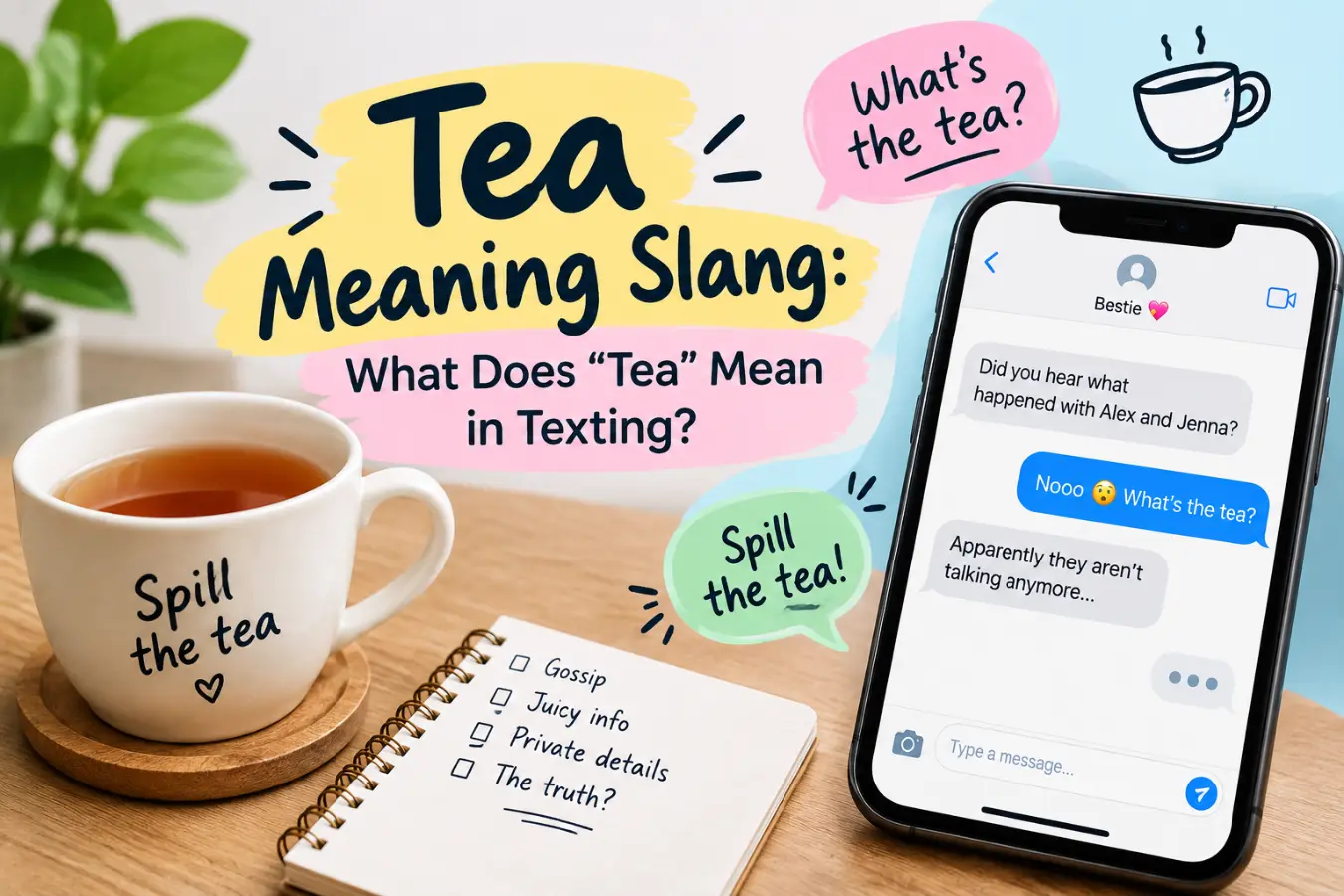
Example 1: Friends texting
Maya: “Did you hear what happened between Alex and Jenna?”
Sara: “Nooo 😭 What’s the tea?”
Maya: “Apparently they aren’t talking anymore.”
Here, tea means the interesting details behind the situation.
Example 2: Asking for gossip
A: “I ran into your old roommate yesterday.”
B: “Wait. Spill the tea.”
The second person wants to hear what happened.
Example 3: Social media
Comment: “Everyone is talking about this. What’s the tea?”
The commenter is asking for the background or explanation.
Example 4: “That’s the tea”
A: “He said he isn’t going to apologize.”
B: “Well, that’s the tea.”
Here, the phrase means something close to “That’s the reality of the situation.”
Does “Tea” Mean Truth?
Sometimes, yes—but “gossip” is the safer general meaning.
One explanation for the slang connects T with “truth.” The expression can therefore overlap with the idea of revealing someone’s real story or private truth. Cambridge notes that T is sometimes used for “truth” in explanations of spill the tea.
However, it would be misleading to treat tea as simply an abbreviation that always stands for “truth.” Historical evidence shows that the slang has also been used directly to mean gossip.
So, depending on context:
- Tea = gossip
- Tea = juicy information
- Tea = private or revealing details
- Tea = truth/facts in some expressions
Where Did the Slang “Tea” Come From?
The exact origin is not completely certain, and it is better not to reduce the history to a single person or moment.
Research into the expression traces its documented use to Black gay culture, with written evidence reaching back at least to the 1970s. William G. Hawkeswood’s 1991 book One of the Children: Gay Black Men in Harlem recorded tea being used to mean gossip and described the expression as Black and originally Southern.
Another important reference is The Lady Chablis, a Black trans performer whose use of “T” for personal truth or private business was recorded in John Berendt’s 1994 book Midnight in the Garden of Good and Evil. This is one reason the “T = truth” explanation became closely associated with the modern expression.
The slang later moved far beyond its original communities and became mainstream internet language. Popular culture, including RuPaul’s Drag Race, helped expose expressions involving “tea” to a much wider audience.
The history matters because today’s casual internet slang comes from real cultural communities rather than appearing from nowhere.
“Tea” vs. “Gossip” vs. “Rumor”
These words overlap, but they are not identical.
| Term | Meaning | Example |
|---|---|---|
| Tea | Interesting or private information, often gossip | “What’s the tea?” |
| Gossip | Talk about other people’s personal affairs | “They were gossiping about their coworkers.” |
| Rumor | Information that is circulating but may not be true | “I heard a rumor they broke up.” |
| Scoop | Interesting information, often something newly discovered | “She got the scoop first.” |
| Truth | Information presented as factual or genuine | “Tell me the truth.” |
One important difference is that tea can sound playful, while rumor highlights uncertainty. If someone says, “I have some tea,” they are not necessarily claiming that every detail is verified.
Common Misunderstandings About “Tea”
“Tea” does not always mean the drink
The surrounding words usually make the meaning clear.
“I want some tea.”
This probably refers to the beverage.
“I want the tea.”
This can refer to gossip or private information.
“Tea” is not always negative
Someone can share funny, surprising, or harmless information and call it tea. The word does not automatically mean malicious gossip.
“Spill the tea” is not literal
In a slang conversation, “spill the tea” means share the information, not physically spill a cup of tea.
When Should You Avoid Using “Tea”?
Tea is informal slang, so it works best in casual communication.
It is natural in:
- Texting friends
- Social media comments
- Casual group chats
- Informal conversations
It is usually better to choose clearer language in formal writing, professional emails, academic work, or official communication.
Instead of:
“Can you spill the tea about the meeting?”
a professional alternative would be:
“Could you share the details about the meeting?”
Key Takeaways
- Tea is slang for gossip, juicy information, or private details.
- “What’s the tea?” means “What’s the gossip?” or “What happened?”
- “Spill the tea” means to reveal or share interesting information.
- “That’s the tea” can mean “That’s the truth” or “That’s how things are.”
- The slang has documented roots in Black gay culture, with evidence dating back at least to the 1970s.
- The meaning is informal, so it is best suited to casual conversations and online communication.
FAQS:
What does “tea” mean in texting?
In texting, tea usually means gossip, interesting information, or private details about a person or situation.
What does “spill the tea” mean?
Spill the tea means to tell someone the gossip or reveal interesting/private information.
Does “tea” mean truth?
It can. In some uses, T is associated with “truth,” but tea is more broadly used for gossip or revealing information.
What does “what’s the tea?” mean?
It means “What happened?”, “What’s the gossip?”, or “Tell me the details.”
What does “that’s the tea” mean?
It can mean “That’s the truth,” “Those are the facts,” or simply “That’s how the situation is.”
Is “tea” rude?
Not usually. It is casual slang, but discussing someone’s private information can still be insensitive depending on what is being shared.
Is “tea” used on TikTok?
Yes. Tea and phrases such as “what’s the tea?” and “spill the tea” are used in social-media conversations, including TikTok. Cambridge gives TikTok-related examples of the slang in current usage.
Is “tea” an acronym?
No. In its modern slang use, tea is generally treated as a slang noun rather than a standard acronym. The connection between T and “truth” is one part of the expression’s history, but it does not mean every use of tea is an acronym for truth.
Conclusion
When you see tea in a text, comment, or social-media post, the safest interpretation is usually gossip, juicy information, or interesting private details. Phrases such as “What’s the tea?” ask for the story, while “spill the tea” asks someone to reveal it.
The slang has a longer cultural history than its modern internet popularity might suggest, with documented roots in Black gay and drag communities before it spread into mainstream online language.

Tayyab Hassan is a Master’s graduate, content writer, and contributor at Meanifiy.com. He specializes in creating informative, reader-friendly content that simplifies language, meanings, and educational topics. With a commitment to accuracy and clarity, he helps readers understand complex concepts through engaging and accessible articles.