When I first see a short abbreviation like OC, I cannot always tell what the person means. The same two letters can carry different meanings depending on the conversation.
If I see OC beside a meme, photo, video, or post, it may mean Original Content. If someone talks about a character they created for a story, game, or fandom, OC usually means Original Character.
In casual texting, I may also see it used as Of Course, although ofc is a clearer and more common choice for that meaning.
People search for OC meaning slang because the abbreviation appears across social media, Reddit, gaming, fandoms, and private chats. The easiest way to understand it is to look at the words around it.
Quick Answer:
In slang and online communication, OC most often means Original Content or Original Character. In casual messages, it can also mean Of Course, so context determines the intended meaning.
What Does OC Mean in Slang?
OC is a context-dependent internet abbreviation.
The two most important meanings are:
- Original Content — something created by the person who posted it.
- Original Character — a fictional character created by an artist, writer, gamer, or fan.
A third meaning, Of Course, appears in informal texting but is less clear because most people use ofc for that phrase.
So, you should not automatically assume that every OC means the same thing.
1. OC Means “Original Content”
Original Content is one of the most common meanings of OC on social media and online communities.
It tells readers that the person sharing something created it themselves rather than simply reposting someone else’s work.
OC can describe:
- A photo you took
- A meme you created
- A video you filmed
- Artwork you made
- A chart or graphic you designed
- A written post or story
- An original edit or project
On Reddit, for example, users may put [OC] in a post title to identify material they created themselves. Similar usage appears in other online communities.
Example
[OC] I made this map for our hiking trip.
Here, OC means Original Content.
Another example:
This video is OC. Please don’t repost it.
The person is saying that they created the video.
How to Recognize This Meaning
If OC appears next to a photo, video, meme, artwork, chart, or post, Original Content is usually the best interpretation.
2. OC Means “Original Character”
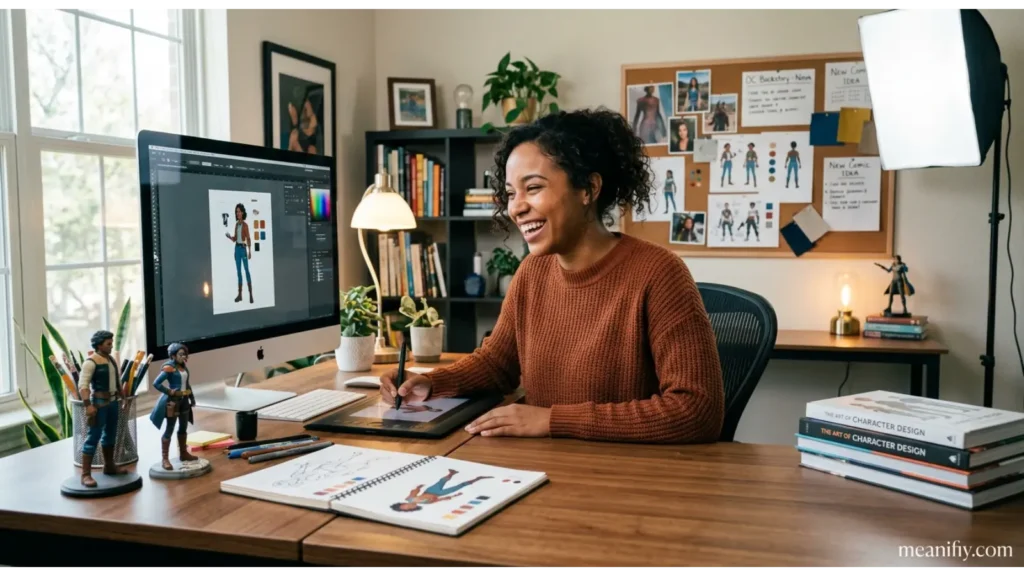
In art, fandom, gaming, roleplay, and creative-writing communities, OC commonly means Original Character.
An original character is a fictional person or creature that someone creates. The character may belong to a completely original story or appear within fan-created work based on an existing fictional universe.
For example, an artist might create a new fantasy character and write:
Meet my new OC!
Here, OC does not mean Original Content. It means Original Character.
Someone might also say:
My OC has blue hair and can control fire.
The conversation is clearly about a fictional character.
This meaning is especially common when people discuss character designs, backstories, fanfiction, roleplay, anime, comics, and games.
OC vs. Canon Character
A canon character is officially part of an established fictional work.
An OC is created by the individual rather than being one of the officially established characters.
For example, if someone creates a new character for a fanfiction story, that character can be their OC while characters from the original franchise remain canon characters.
3. OC Means “Of Course”
In casual texting, OC can sometimes mean Of Course.
For example:
“Can you send me the notes?”
“OC, give me a minute.”
Here, OC means Of Course.
However, this usage can cause confusion because ofc is much easier to recognize as “of course.” Dictionaries and slang references do record oc as an internet abbreviation for “of course,” but it is not the safest interpretation when the conversation is about content or characters.
A Simple Rule
If OC is a reply to a question, it could mean Of Course.
If OC describes a post or creation, it probably means Original Content.
If OC describes a fictional character, it probably means Original Character.
How to Tell Which OC Meaning Someone Means
Context is the best clue.
| If you see OC with… | It probably means… |
| A photo or video | Original Content |
| A meme or chart | Original Content |
| Artwork of a character | Original Character |
| A character’s name or backstory | Original Character |
| A fanfiction or roleplay discussion | Original Character |
| A quick reply to a question | Of Course |
For example:
“Check out my OC!”
This could mean Original Character if the person is showing a fictional character.
But:
“[OC] Check out this sunset photo.”
Here, it almost certainly means Original Content.
The surrounding words remove most of the confusion.
Where Is OC Used?
On Reddit, OC commonly identifies content created by the person posting it. You may see [OC] attached to a post containing an original photo, graphic, chart, meme, or written creation.
Instagram and TikTok
Creators may use OC when talking about their own artwork, videos, edits, memes, or other creations. The exact meaning can depend on the post.
Discord and Gaming Communities
In gaming and Discord communities, OC can mean Original Character, especially when players discuss custom characters, roleplay, or fictional worlds.
It can also mean Original Content when people share something they personally created.
Fandom and Art Communities
This is one of the strongest contexts for the Original Character meaning. Artists and writers often discuss their OCs, character designs, personalities, and stories.
Real Conversation Examples
Example 1: Original Content
Mia: “Did you take this picture?”
Alex: “Yeah, it’s OC.”
Mia: “Nice shot!”
Here, OC means Original Content.
Example 2: Original Character
Sam: “Who is that girl in your drawing?”
Lena: “She’s my OC.”
Sam: “I love her design.”
Here, OC means Original Character.
Example 3: Of Course
Jake: “Are you coming to the party?”
Ryan: “OC! I wouldn’t miss it.”
Here, OC means Of Course.
Example 4: Gaming
Player 1: “I finally finished my OC’s armor.”
Player 2: “That design looks awesome.”
Here, OC refers to an Original Character.
Is OC the Same as “Original”?
Not always.
Someone may use OC to say that a piece of content is their own creation. In that case, Original Content is the intended meaning.
But when someone says “my OC,” especially while discussing a fictional person, they are usually talking about an Original Character.
So, the phrase around OC matters more than the abbreviation itself.
OC vs. OFC vs. OP
These abbreviations are easy to mix up.
- OC — Original Content, Original Character, or sometimes Of Course
- OFC — Of Course
- OP — Original Poster, especially on forums such as Reddit
If you want to say “of course” in a text, OFC is usually clearer than OC because OC already has several established meanings.
Is OC Formal or Informal?
OC is informal.
You can use it comfortably in casual chats, social media posts, gaming communities, fandom discussions, and online forums.
I would avoid using OC in a formal email or professional document unless the people reading it already understand the abbreviation.
Instead of:
OC, I’ll send the file later.
A professional message would be clearer as:
Of course, I’ll send the file later.
Likewise, if you are describing content professionally, write original content instead of assuming everyone understands OC.
Common Misunderstandings About OC
“OC always means Of Course.”
Not necessarily. In online communities, Original Content and Original Character are very common meanings.
“OC always means Original Character.”
Again, no. If someone labels a photo or post [OC], they may be saying that they created the content themselves.
“OC and OFC always mean the same thing.”
They can overlap when OC is being used as “of course,” but OFC is much clearer for that meaning.
“You can understand OC without context.”
This is the biggest mistake. The topic surrounding the abbreviation usually tells you what it means.
Key Takeaways
- OC has several meanings in online communication.
- Original Content is common when discussing posts, photos, videos, and artwork.
- Original Character is common in fandom, gaming, art, and writing communities.
- Of Course is another informal texting meaning, but ofc is clearer.
- The surrounding conversation usually reveals the intended meaning.
- OC is casual and should be used carefully in professional communication.
Frequently Asked Questions
What does OC mean in slang?
OC can mean Original Content, Original Character, or sometimes Of Course. The correct meaning depends on the context.
What does OC mean on social media?
On social media, OC often means Original Content. It tells people that the creator made the photo, video, meme, artwork, or other post themselves.
What does OC mean in gaming?
In gaming and roleplay communities, OC commonly means Original Character. It refers to a character created by the player or community member.
What does OC mean on Reddit?
On Reddit, OC commonly means Original Content. A user may add [OC] to show that they created the material in the post.
What does “my OC” mean?
“My OC” usually means “my original character.” It often appears when artists, writers, gamers, or fans introduce a fictional character they created.
Does OC mean “of course”?
Yes, it can. In informal texting, OC may mean Of Course, but OFC is generally clearer because OC has other common meanings.
Is OC slang?
Yes. OC functions as an informal internet abbreviation in texting and online communities. Its meaning changes according to the community and conversation.
Conclusion
OC meaning slang is not limited to one definition. If I see OC beside a post, photo, meme, or video, I would first consider Original Content.
If the conversation involves a fictional character, artwork, gaming, or fanfiction, Original Character is usually the better interpretation. In a quick text reply, Of Course is also possible, although OFC is clearer.
The safest approach is simple: look at the context before deciding what OC means. Once you know what the conversation is about, the intended meaning is usually easy to spot.

Tayyab Hassan is a Master’s graduate, content writer, and contributor at Meanifiy.com. He specializes in creating informative, reader-friendly content that simplifies language, meanings, and educational topics. With a commitment to accuracy and clarity, he helps readers understand complex concepts through engaging and accessible articles.