You may have seen someone write, “PM me the details” or “I’ll PM you later.” If you were unsure what they meant, you are not alone. PM can have different meanings depending on where you see it.
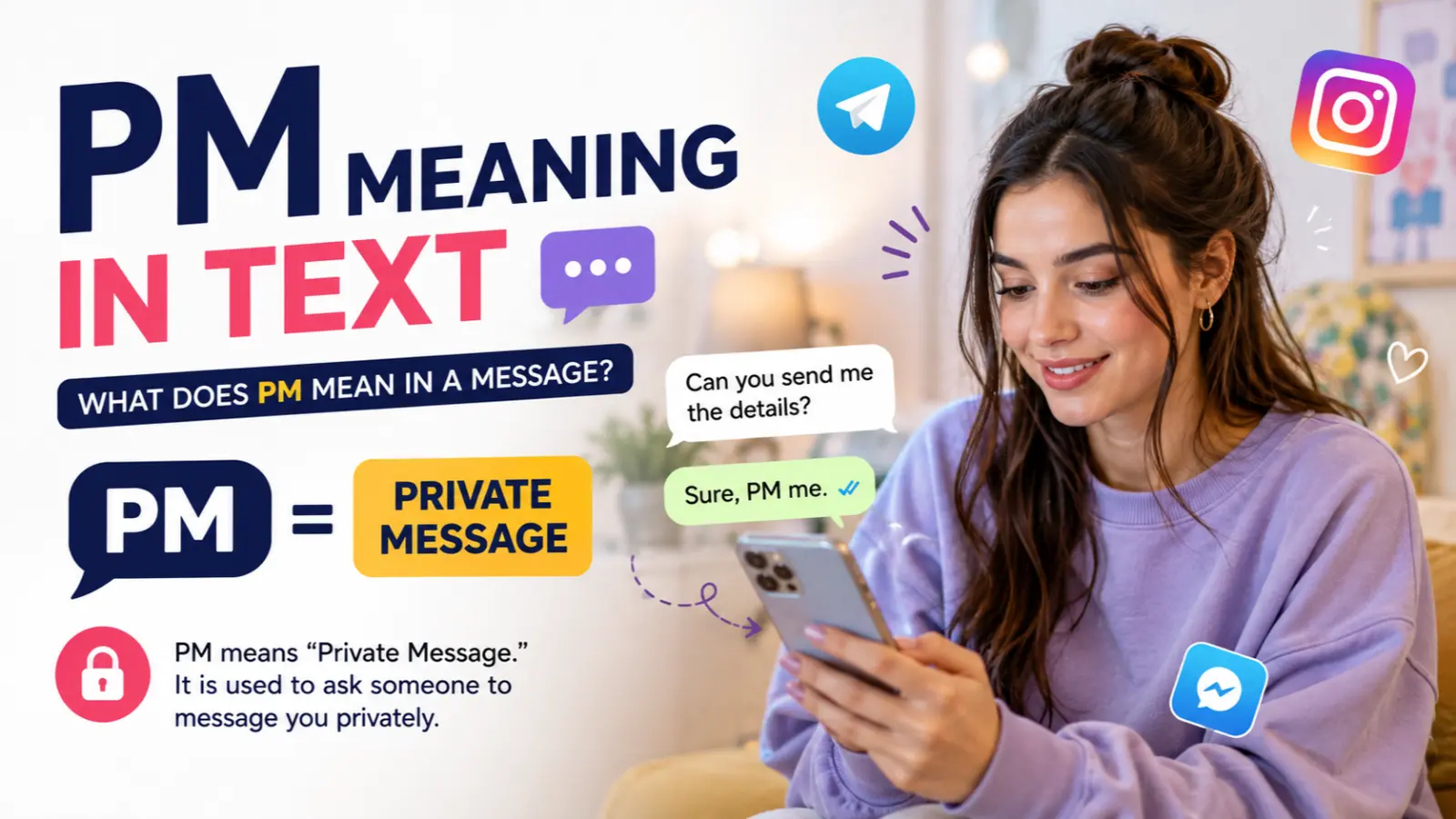
In texting and online conversations, PM most often means “Private Message.” It tells someone to contact them through a private chat instead of posting the conversation publicly.
However, PM can also mean “p.m.” when talking about time, “Prime Minister” in news or politics, and other terms in work or technical settings.
Quick Answer
PM meaning in text is usually “Private Message.” People use it to ask someone to send or receive a message privately. PM can also have other meanings, so the surrounding conversation helps you understand the intended meaning.
What Does PM Meaning in Text?
In texting and social media, PM usually stands for “Private Message.”
A private message is a conversation that is not visible to everyone. You might use PM when you want to share personal information, ask a question, or continue a conversation away from a public post.
For example:
“PM me your number.”
This means:
“Send me your number in a private message.”
You may also see:
- PM me = Send me a private message.
- I’ll PM you = I’ll send you a private message.
- Check your PMs = Check your private messages.
- Send me a PM = Send me a private message.
PM is common in online communities, social platforms, forums, gaming spaces, and direct-message conversations.
PM Full Form in Text
The most common full form of PM in texting is “Private Message.”
It is similar to terms such as DM, which means “Direct Message.”
The exact term can vary by platform. Some platforms call private conversations DMs, while older forums and online communities often use PM.
PM vs. DM
PM and DM usually serve the same purpose: a private online conversation.
| Term | Meaning | Common use |
| PM | Private Message | Forums, online communities, chats |
| DM | Direct Message | Instagram, X, TikTok, social media |
| Message | General private message | Texting and chat apps |
For example:
“PM me the information.”
= Send me the information privately.
“DM me the information.”
= Send me the information privately.
The difference is often about platform terminology rather than the basic idea.
Other Meanings of PM
PM does not always mean “Private Message.” Context matters.
1. PM = Private Message
Popularity: Very common online
This is the meaning most relevant to texting and online chats.
Example:
“PM me when you’re free.”
Meaning: Send me a private message when you are free.
2. PM = Post Meridiem / p.m.
Popularity: Very common in time expressions
In “8 PM”, PM refers to the period from noon to midnight.
For example:
“The movie starts at 8 PM.”
Here, PM has nothing to do with private messages.
A useful clue is capitalization and placement. “PM me” usually means private message, while “8 PM” refers to time.
PM Meaning in Text = Prime Minister
Popularity: Common in news and political discussions
PM can refer to a Prime Minister, especially in news reports and political writing.
Example:
“The PM addressed the nation today.”
Here, PM refers to the country’s prime minister, not a private message.
4. PM = Project Manager
Popularity: Common in workplace communication
In business or tech settings, PM can mean Project Manager.
Example:
“The PM will review the timeline tomorrow.”
The meaning depends heavily on the workplace context.
5. PM = Product Manager
In technology and business, PM can also mean Product Manager.
Example:
“Ask the PM about the new feature.”
Someone working on a software team may understand PM as Product Manager rather than Private Message.
How People Use PM in Real Conversations
Here are some natural examples.
Example 1: Social Media
Alex: “Can you send me the price?”
Sam: “Sure. PM me.”
Meaning: Sam wants Alex to contact them privately.
Example 2: Online Community
User 1: “I have the file you need.”
User 2: “Could you PM it to me?”
Meaning: Send it through a private message.
Example 3: Personal Conversation
Mia: “I need to tell you something.”
Jake: “PM me.”
Meaning: Send me a private message so we can talk privately.
Example 4: Buying Something Online
Buyer: “Is this still available?”
Seller: “Yes. PM me for the details.”
Meaning: Contact the seller privately for more information.
Example 5: Time
Friend: “Can we talk at 9 PM?”
Here, PM means the evening time period, not private message.
Where Is PM Commonly Used?
You can see PM in many types of online conversations, especially where private communication is available.
Social Media
People may use PM when asking someone to move a public conversation into a private chat.
“PM me your contact details.”
Online Forums
PM is especially natural in forums and online communities where members can privately contact each other.
“I sent you a PM.”
Gaming
Gamers may use PM when asking another player to contact them privately.
“PM me after the match.”
Workplace Chats
PM can appear in workplace messages, but the meaning can change.
“PM me the document.”
Here, it may mean private message.
But:
“The PM approved the plan.”
could mean Project Manager or Product Manager.
That is why context matters.
PM Meaning on Social Media
On social media, PM usually means Private Message, although DM is often more common on modern platforms.
If someone says:
“PM me.”
they are asking you to contact them privately.
If someone says:
“Check your PM.”
they want you to look at a private message they sent.
On some platforms, users may say DM instead because the platform officially calls its private messaging feature direct messages.
How Do You Know Which Meaning PM Has?
Look at the words around PM.
PM + “me”
“PM me.”
Meaning: Private message me.
PM + a number
“Call me at 7 PM.”
Meaning: Time.
PM + political context
“The PM announced new measures.”
Meaning: Prime Minister.
PM + workplace project
“The PM needs the report.”
Meaning: Project Manager or Product Manager.
This simple context check usually makes the meaning clear.
Is PM Formal or Informal?
When PM means “Private Message,” it is generally informal and digital.
It works well in:
- Online chats
- Forums
- Social media
- Gaming communities
- Casual workplace messaging
For a formal email, it is usually clearer to say “Please send me a private message” or simply explain exactly where the person should contact you.
For example, instead of:
“PM me the report.”
A more professional version could be:
“Please send me the report directly.”
The best choice depends on your relationship with the reader and the communication channel.
Common Misunderstandings About PM
One common mistake is assuming PM always means “Private Message.”
It does not.
Consider these two sentences:
“PM me when you arrive.”
Here, PM means Private Message.
“Arrive at 6 PM.”
Here, PM refers to time.
Another common misunderstanding happens in workplace chats. PM may mean Project Manager or Product Manager instead of Private Message.
The surrounding words usually provide the answer.
PM vs. Other Common Chat Abbreviations
| Abbreviation | Meaning | Typical use |
| PM | Private Message | Private online communication |
| DM | Direct Message | Social media and online chats |
| IM | Instant Message | Online messaging |
| PM me | Private message me | Asking someone to contact you privately |
| FYI | For Your Information | Sharing information |
| BTW | By the Way | Adding a side point |
PM and DM are the closest in meaning. In many conversations, either one can communicate the idea of contacting someone privately.
Frequently Asked Questions
What does PM meaning in a text message?
PM usually means “Private Message.” It can mean that someone wants you to contact them privately.
What does “PM me” mean?
“PM me” means “send me a private message.” The person is asking you to contact them outside the public conversation.
Is PM the same as DM?
Usually, yes. PM means Private Message, while DM means Direct Message. Both generally refer to private online communication.
PM Meaning in Text on social media?
On social media, PM commonly means Private Message. However, many platforms use the term DM instead.
What does PM mean in “8 PM”?
In “8 PM,” PM refers to the time period after noon and before midnight. It does not mean private message.
Can PM mean Prime Minister?
Yes. In news and political discussions, PM can mean Prime Minister.
Can PM have a different meaning at work?
Yes. In workplace conversations, PM can mean Project Manager or Product Manager, depending on the organization and topic.
Is “PM me” rude?
No. “PM me” is generally neutral and informal. However, a more polite or professional phrase may be better in formal communication.
Key Takeaways
- PM usually means “Private Message” in online chats.
- “PM me” means “send me a private message.”
- PM is similar to DM (Direct Message).
- “PM” can also refer to time, as in 8 PM.
- In news, PM can mean Prime Minister.
- At work, PM may mean Project Manager or Product Manager.
- Always use the surrounding context to determine the intended meaning.
Conclusion
When you see PM in a text or online conversation, the safest first interpretation is usually “Private Message.” If someone says “PM me,” they want you to contact them privately.
Still, PM has several other meanings. It can describe a time of day, a Prime Minister, or a workplace role such as Project Manager or Product Manager.
The words around PM usually reveal what the writer means. Once you check the context, this short abbreviation is usually easy to understand.

Tayyab Hassan is a Master’s graduate, content writer, and contributor at Meanifiy.com. He specializes in creating informative, reader-friendly content that simplifies language, meanings, and educational topics. With a commitment to accuracy and clarity, he helps readers understand complex concepts through engaging and accessible articles.