ASL Meaning Slang: What Does ASL Mean in Text & Social Media?
You may see a message like “I’m tired asl” or “That movie was funny asl” and wonder what the three letters mean. If you learned older internet slang, you might know ASL as “age, sex, location.” That is why this abbreviation can be confusing.
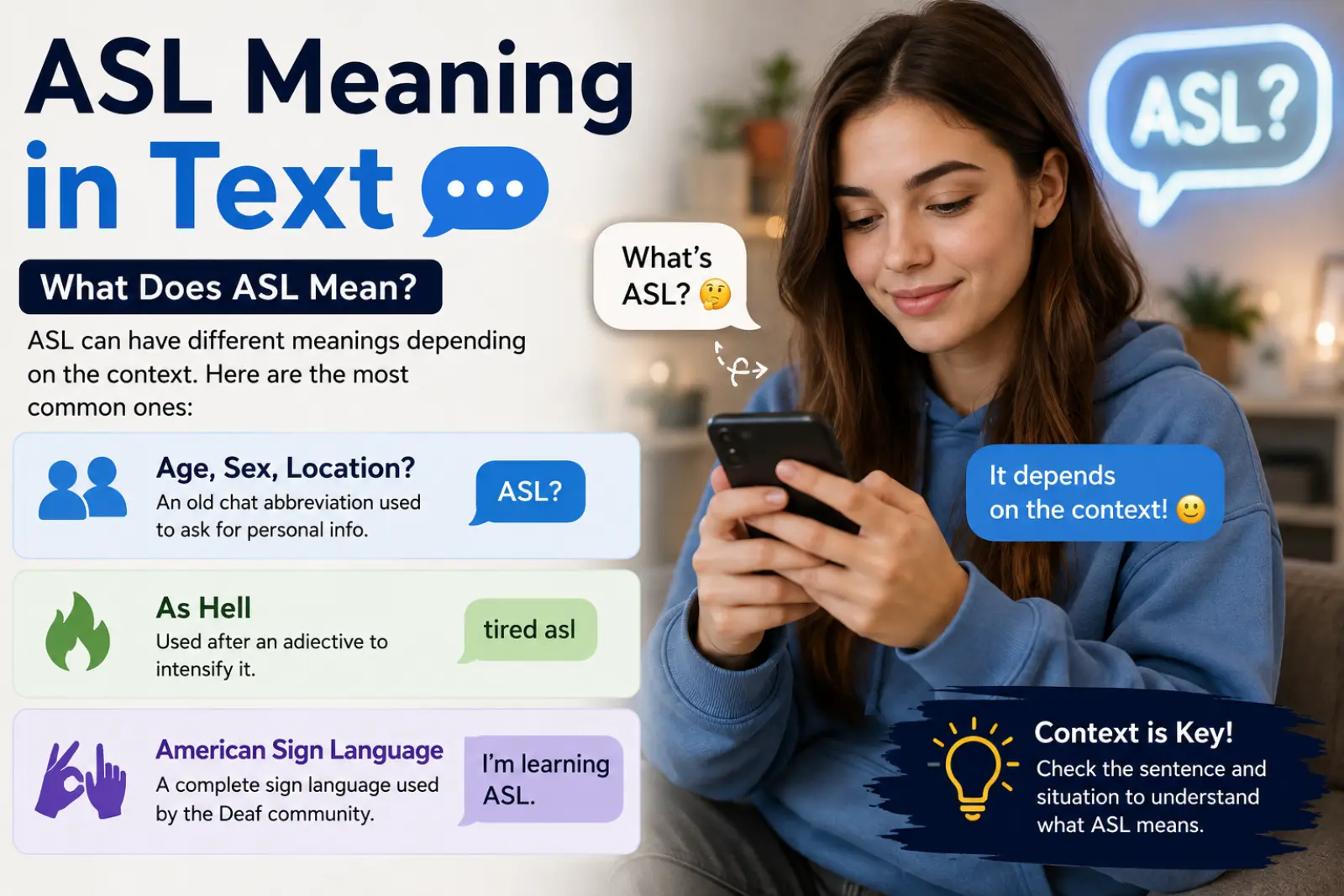
Today, lowercase “asl” is widely used as slang for “as hell.” It usually appears after an adjective or description to add strong emphasis. You may see it in texts, TikTok comments, Snapchat messages, Instagram comments, Discord chats, and other casual online conversations.
Quick Answer
In modern slang, asl usually means “as hell.” For example, “I’m hungry asl” means “I’m very hungry” or “I’m hungry as hell.” However, ASL can also mean the older “age, sex, location” or American Sign Language, so context matters.
The words around ASL usually tell you which meaning the sender intends.
What Does ASL Mean in Text?
When you see ASL? by itself in an online conversation, the traditional meaning is:
Age, Sex, Location?
It was a quick way for strangers in chatrooms to ask:
- How old are you?
- What is your sex or gender?
- Where are you located?
This abbreviation became associated with early internet chat and instant messaging. It was especially common when people met strangers online and had no profile information to view.
For example:
Person 1: Hey, ASL?
Person 2: 24, male, Texas.
You may also see it written as A/S/L.
Is “Age, Sex, Location?” still common?
You may still encounter it in chatrooms, dating conversations, or older internet communities, but it is much less central to everyday messaging than it once was.
Today, people often share age, gender, and location through profiles instead of asking for all three with one abbreviation.
Also, giving your exact location to a stranger online can create a privacy risk. You do not have to answer an ASL request.
ASL Meaning: “As Hell”
A different modern slang use of asl is “as hell.”
Here, it works as an intensifier. It makes the word before it stronger.
For example:
- “I’m tired asl.” → I’m extremely tired.
- “That was funny asl.” → That was very funny.
- “She’s confident asl.” → She’s extremely confident.
- “This game is hard asl.” → This game is extremely hard.
This meaning is easy to recognize because asl usually appears at the end of a sentence or phrase after an adjective.
So compare:
“ASL?”
→ likely Age, Sex, Location?
“I’m tired asl.”
→ likely tired as hell
Online slang references document both meanings, while community discussions also show that people sometimes interpret the abbreviation differently based on age and internet experience.
Is “as hell” rude?
It is informal and contains the word “hell,” so it may not fit professional communication.
With friends, casual texting, TikTok comments, or gaming chats, it can sound natural.
At work, in formal writing, or when speaking to someone you do not know well, use clearer alternatives such as:
- very
- extremely
- really
- incredibly
For example:
Casual: “That test was hard asl.”
Professional: “That test was extremely difficult.”
ASL Meaning: American Sign Language
ASL also stands for American Sign Language.
This is not slang. It is a complete, natural language with its own grammar and linguistic structure. ASL uses hand movements, facial expressions, body movements, and visual-spatial features to communicate. It is distinct from English.
For example:
“I’m learning ASL.”
Here, the person is talking about American Sign Language, not internet slang.
ASL is primarily used in the United States and in parts of Canada. It should not be confused with British Sign Language (BSL), because sign languages are not universal. Different countries and regions can have different sign languages.
How to Tell Which ASL Meaning Someone Means
Context is the key.
| Example | Likely meaning |
|---|---|
| “ASL?” | Age, Sex, Location? |
| “What’s your ASL?” | Age, Sex, Location |
| “I’m tired asl.” | As hell |
| “That food was good asl.” | As hell |
| “I’m taking an ASL class.” | American Sign Language |
| “She knows ASL.” | American Sign Language |
A simple rule can help:
1 ASL by itself as a question → Age, Sex, Location?
2 asl after an adjective → As hell
3 ASL connected to signing or language → American Sign Language
Real Conversation Examples
1. Old-school chat meaning
Alex: Hey, ASL?
Jordan: 21, F, Chicago.
Here, ASL asks for age, sex, and location.
2. Modern slang
Mia: How was the concert?
Sam: It was amazing asl 😂
Here, asl means “as hell.”
3. Talking about sign language
Tom: What language are you learning?
Sara: ASL. I want to communicate with my Deaf friends.
Here, ASL means American Sign Language.
4. Gaming chat
Player 1: This boss is hard asl.
Player 2: Fr 😭
Here, asl intensifies “hard.”
5. Someone asking personal information
Stranger: ASL?
You: I don’t share personal details online.
This is a perfectly reasonable response. You never need to give a stranger your age or location.
ASL on TikTok, Snapchat, and Other Social Media
On social media, asl is more likely to appear as part of a sentence when it means “as hell.”
For example:
- “Cute asl”
- “Funny asl”
- “Cold asl”
- “Busy asl”
- “That edit goes hard asl”
The meaning becomes clear because asl follows a descriptive word.
If someone simply sends:
“ASL?”
the older “Age, Sex, Location?” interpretation makes much more sense.
The platform alone does not always determine the meaning. Sentence structure and surrounding words matter more.
Is ASL a Bad Word?
ASL itself is not a bad word. Its meaning depends on how someone uses it.
- Age, Sex, Location? — informal and potentially intrusive.
- As hell — casual and mildly profane.
- American Sign Language — the name of a language.
If someone asks you for your age and location online, you can simply decline. This is especially sensible when you are talking to a stranger.
Common Misunderstandings About ASL
“ASL always means American Sign Language.”
Not necessarily. In a message such as “That was amazing asl,” it means “as hell,” not American Sign Language.
“ASL always means Age, Sex, Location?”
Not today. That meaning is strongly associated with older internet chat culture. Modern slang has added another common interpretation.
“ASL is just English translated into hand signs.”
No. American Sign Language is a separate language with its own grammar and syntax. The National Association of the Deaf and the National Institute on Deafness and Other Communication Disorders both describe ASL as a complete language distinct from English.
“There is one universal sign language.”
There is not. Different countries and regions use different sign languages, just as spoken languages vary around the world.
Where Did the Slang Meaning Come From?
The exact person who created A/S/L is not known. The abbreviation became popular with the growth of online chatrooms and instant messaging, especially during the early internet era. It allowed strangers to ask three personal questions quickly.
The modern “as hell” usage is a separate slang development. It is often seen in lowercase, especially in casual social media posts and text messages.
Because slang changes quickly, the two meanings can overlap across generations. Someone familiar with older chat culture may read ASL as “age, sex, location,” while a younger social-media user may read asl as “as hell.”
ASL vs. Similar Abbreviations
| Term | Meaning | Main use |
|---|---|---|
| ASL? | Age, Sex, Location? | Online chat |
| asl | As hell | Modern texting/slang |
| ASL | American Sign Language | Language and accessibility |
| A/S/L | Age, Sex, Location | Older internet chat |
| BSL | British Sign Language | Sign language |
The biggest difference is context. Punctuation, capitalization, and the words around the abbreviation can quickly change its meaning.
When Should You Avoid Using ASL?
If you mean “Age, Sex, Location?”, avoid asking strangers for detailed personal information unless there is a clear reason.
If you mean “as hell,” avoid it in formal emails, academic writing, job applications, and professional documents.
Instead of:
“This report is confusing asl.”
write:
“This report is extremely confusing.”
And if someone sends you “ASL?” and you do not know them, you can simply say:
“I’d rather not share personal information.”
Key Takeaways
- ASL has several meanings, so context matters.
- ASL? traditionally means “Age, Sex, Location?”
- asl can mean “as hell” in modern online slang.
- ASL also means American Sign Language, a complete natural language.
- Do not share personal information with strangers just because they ask “ASL?”
- Look at the sentence structure and surrounding words before deciding what ASL means.
The Basics of American Sign Language (ASL)
American Sign Language (ASL) is a complete visual language used mainly by Deaf and hard-of-hearing communities in the United States and parts of Canada.
Unlike spoken English, ASL uses hand movements, facial expressions, body posture, and space to communicate meaning. It has its own grammar and sentence structure, so it is not simply English translated into hand signs.
Key basics of ASL
- ASL is a natural language, not a collection of gestures.
- It has its own grammar and vocabulary.
- Meaning can change through facial expressions and body movement, not just hand shapes.
- ASL uses the hands, face, head, and upper body during communication.
- It differs from other signed languages, such as British Sign Language (BSL).
- Fingerspelling uses hand shapes to represent individual letters, often for names or words without a known sign.
ASL and English Are Different
A common misunderstanding is that ASL follows English word order. It does not always.
For example, English might say:
“What is your name?”
An ASL sentence can use a different structure and rely on facial expression to show that it is a question.
This is one reason ASL should be treated as a language in its own right, rather than as a signed version of spoken English.
Why ASL Matters
ASL gives Deaf people a way to communicate, learn, socialize, work, and express themselves through a visual language. Learning even basic signs can also make everyday communication more accessible and welcoming.
And in the context of your “ASL meaning slang” article, this is the key distinction: when someone writes “tired asl” online, they usually mean “tired as hell.” When someone says they are learning ASL, they are most likely talking about American Sign Language.
FAQs About ASL Meaning
What does ASL mean in texting?
In texting, ASL can mean “Age, Sex, Location?” or “as hell.” The sentence usually makes the intended meaning clear.
What does “ASL?” mean from a stranger?
If someone sends only “ASL?”, they most likely mean “Age, Sex, Location?” They are asking for basic personal details.
What does “cute asl” mean?
“Cute asl” means “cute as hell” or simply “very cute.” It is casual internet slang.
What does ASL mean on TikTok?
On TikTok, asl can mean “as hell”, especially when it follows an adjective. For example, “funny asl” means “very funny.”
What does ASL mean in school?
In a school or education setting, ASL usually means American Sign Language, especially when discussing language classes, Deaf education, or communication.
Is ASL the same as American Sign Language?
Sometimes. ASL is the standard abbreviation for American Sign Language, but in online slang it can mean other things. Context determines which meaning applies.
Is “as hell” a common meaning of asl?
Yes, it is a recognized modern internet-slang use. It commonly appears after adjectives in casual messages and social-media posts.
Should I answer an “ASL?” message?
You do not have to. If the person is a stranger, consider protecting your privacy rather than sharing your age, gender, or location.
Conclusion
ASL is a classic example of how one abbreviation can develop several meanings online. In older chat culture, ASL? meant “Age, Sex, Location?” Today, asl can also mean “as hell,” while ASL remains the widely recognized abbreviation for American Sign Language.
When you see ASL, do not rely on the letters alone. Check what comes before and after them. That small bit of context usually tells you exactly what the sender means.

Tayyab Hassan is a Master’s graduate, content writer, and contributor at Meanifiy.com. He specializes in creating informative, reader-friendly content that simplifies language, meanings, and educational topics. With a commitment to accuracy and clarity, he helps readers understand complex concepts through engaging and accessible articles.