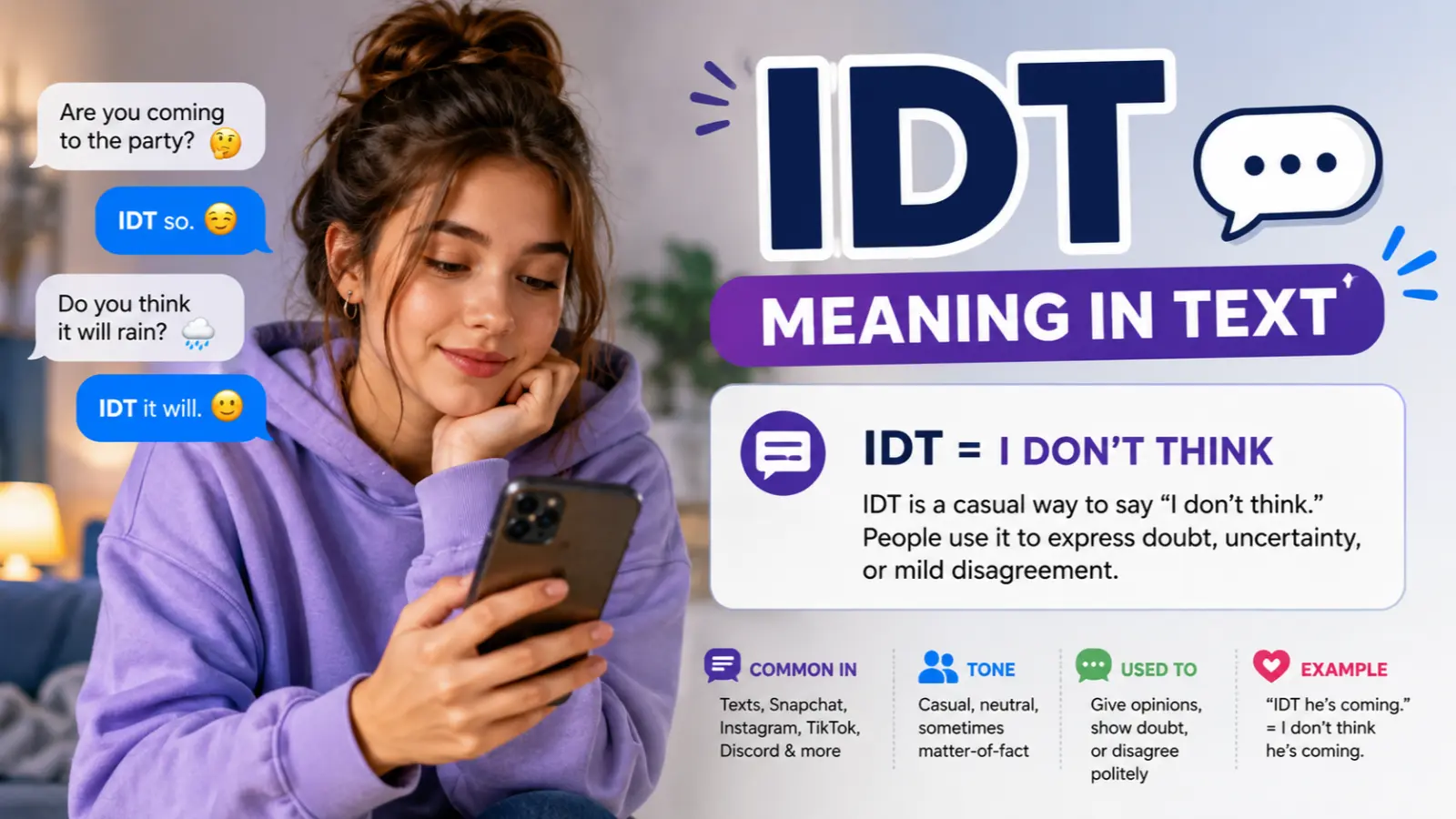
IDT Meaning in Text: What Does IDT Mean in Messages?
Have you ever received a message like “IDT so” and wondered what those three letters meant? If you have, you are not alone. Texting is full of short forms that can be hard to understand when you see them for the first time.
In casual messages, social media chats, and online conversations, IDT usually means “I don’t think.” People use it when they are unsure about something, disagree with an idea, or want to give a negative answer without sounding too direct.
The exact meaning can depend on the situation, though. IDT also has unrelated meanings in technical, business, military, and other fields.
Quick Answer
IDT most commonly means “I don’t think” in text messages and online chats. It is usually used to express doubt, uncertainty, or mild disagreement. Other meanings exist in professional and technical contexts, but “I don’t think” is the meaning most relevant to texting.
What Does IDT Meaning in Text?
In texting, IDT = “I don’t think.”
It is an informal abbreviation that makes a sentence shorter and faster to type.
For example:
“IDT he’s coming tonight.”
This means:
“I don’t think he’s coming tonight.”
Another common form is:
“IDT so.”
That normally means:
“I don’t think so.”
People often use IDT when they want to express an opinion without sounding completely certain.
What feeling does IDT express?
Depending on the sentence, IDT can communicate:
- Doubt
- Uncertainty
- Mild disagreement
- A negative prediction
- A personal opinion
- A cautious response
For example, “IDT that will work” is less blunt than “That won’t work.”
That difference matters in texting because short messages can sometimes sound harsher than intended.

Is IDT a Slang Word or an Acronym?
IDT is best described as a texting abbreviation or initialism.
It comes from the first letters of:
I — I
D — Don’t
T — Think
It is mainly used in written digital communication rather than spoken conversation. Reference sources consistently identify “I don’t think” as the common texting meaning.
You would normally type IDT rather than say “I-D-T” aloud.
How People Use IDT in Real Conversations
The meaning becomes much clearer when you see it in natural conversations.
Example 1: Making plans
Alex: Are you coming to the party tonight?
Sam: IDT so. I have too much work.
Here, IDT means “I don’t think so.”
Example 2: Expressing doubt
Mia: Do you think Jake will remember?
Noah: IDT he will.
The person thinks Jake probably will not remember.
Example 3: Disagreeing
Lena: This is the best restaurant in town.
Chris: IDT 😂 I like the one downtown better.
Here, IDT shows a casual disagreement.
Example 4: Giving an opinion
A: Should I buy this laptop?
B: IDT it’s worth that price.
The speaker is giving a negative or doubtful opinion.
Example 5: Being unsure
A: Is the store still open?
B: IDT. Check Google Maps.
Here, IDT suggests uncertainty rather than a firm “no.”
IDT vs. “I Don’t Think So”
These two expressions are closely related, but they do not always appear in exactly the same way.
| Expression | Meaning | Typical use |
|---|---|---|
| IDT | I don’t think | Before a statement or as a short reply |
| IDT so | I don’t think so | Usually a negative answer |
| I don’t think | Full phrase | Casual or formal writing |
| I doubt it | Probably not | Stronger expression of doubt |
| IDK | I don’t know | Lack of knowledge, not necessarily disagreement |
For example:
“Will Sarah come?”
“IDT so.”
The person is saying they believe Sarah probably will not come.
But:
“Will Sarah come?”
“IDK.”
means the person simply does not know.
That distinction is useful when interpreting a short reply.
Where Is IDT Used?
Because IDT is informal shorthand, it fits best in casual digital communication.
You may encounter it in:
- Text messages
- Private chats
- Social media messages
- Online forums
- Gaming chats
- Casual group conversations
The abbreviation is documented specifically in online chat and text messaging usage.
It is less suitable for formal documents, business reports, academic writing, or professional emails.
Does IDT Sound Rude?
Not usually.
IDT is normally neutral and casual. However, tone depends on the message around it.
Compare:
“IDT that’s right.”
This can sound like a simple correction.
But:
“IDT 🙄”
could sound dismissive or annoyed because of the emoji and context.
If someone sends only “IDT”, the message may feel a little abrupt. That does not automatically mean they are angry. They may simply be replying quickly.
When the topic is sensitive, writing the full phrase can make your meaning clearer.
IDT on Snapchat, TikTok, and Social Media
If you see IDT in a Snapchat message, TikTok comment, Instagram DM, or another casual online conversation, “I don’t think” is usually the most sensible interpretation when the surrounding sentence fits.
For example:
“idt that’s gonna happen 😭”
means:
“I don’t think that’s going to happen.”
The lowercase form “idt” is also common because people often type texting abbreviations in lowercase.
There is no special Snapchat-only or TikTok-only meaning that you need to assume. Context matters more than the platform.
Does IDT Have Other Meanings?
Yes. IDT is not limited to texting.
Abbreviation databases list many unrelated meanings for IDT across different fields. For example, it can refer to technical, military, business, scientific, and organizational terms.
Some examples include:
- Integrated Device Technology — a technology-related term
- Interrupt Descriptor Table — a computing term
- Inactive Duty Training — a military term
- Integrated Digital Terminal — a telecommunications term
These meanings are not normally relevant when someone sends “IDT” in a casual text.
So, always consider the setting.
If your friend texts “IDT he’s coming,” they almost certainly mean “I don’t think he’s coming.”
If you see IDT in a technical document, the meaning may be completely different.
Common Misunderstandings About IDT
“Does IDT mean I don’t know?”
No. IDK is the common abbreviation for “I don’t know.”
IDT means “I don’t think.”
Does IDT always mean “I don’t think so”?
Not necessarily.
The abbreviation can appear before a complete statement:
“IDT she knows.”
That means:
“I don’t think she knows.”
When someone writes “IDT so,” however, the intended phrase is usually “I don’t think so.”
Is IDT the same as saying “No”?
Not exactly.
“No” is direct.
“IDT” often expresses doubt or a softer disagreement. The speaker may not be completely certain.
When Should You Avoid Using IDT?
IDT works well with friends and people who understand texting shorthand.
Avoid it when clarity and formality matter, such as:
- Job applications
- Academic assignments
- Business reports
- Formal emails
- Official documents
- Important customer communication
Instead of:
“IDT this is possible.”
Use:
“I don’t think this is possible.”
The full phrase is clearer and more professional.
Key Takeaways
- IDT usually means “I don’t think” in texting.
- “IDT so” means “I don’t think so.”
- It can express doubt, uncertainty, or mild disagreement.
- IDT is common in casual digital communication.
- It is not usually rude, but a short reply can sometimes sound blunt.
- IDT has other meanings in technical and professional fields, so context matters.
FAQs:
What does IDT mean in a text message?
IDT usually means “I don’t think.” It is a casual abbreviation used to express doubt, uncertainty, or disagreement.
What does “IDT so” mean?
“IDT so” means “I don’t think so.” It is generally used as a casual negative or doubtful response.
Is IDT rude?
No. IDT is normally neutral and informal. However, sending only “IDT” can sometimes feel blunt, depending on the conversation.
What is the difference between IDT and IDK?
IDT means “I don’t think,” while IDK means “I don’t know.” IDT usually expresses an opinion or doubt; IDK expresses a lack of knowledge.
Can I use IDT in a professional email?
It is better to avoid it. Use “I don’t think” instead when writing to clients, managers, teachers, or other professional contacts.
Does IDT have meanings besides “I don’t think”?
Yes. IDT has many meanings in technical, military, business, scientific, and organizational contexts. The texting meaning is “I don’t think.”
Is IDT used on social media?
Yes. You can encounter it in casual online conversations, comments, and messages. Its meaning is usually clear from the surrounding text.
Final Thoughts
When you see IDT in a casual text, the safest interpretation is “I don’t think.” It is a quick way to show doubt, give an opinion, or disagree without writing the full phrase.
The context still matters. “IDT so” usually means “I don’t think so,” while “IDT she’s coming” means “I don’t think she’s coming.” In technical or professional settings, IDT can stand for something completely different, so do not rely on the texting meaning outside a chat context.

Tayyab Hassan is a Master’s graduate, content writer, and contributor at Meanifiy.com. He specializes in creating informative, reader-friendly content that simplifies language, meanings, and educational topics. With a commitment to accuracy and clarity, he helps readers understand complex concepts through engaging and accessible articles.