IDTS Meaning in Text: What Does IDTS Mean in Chat?
If someone sends you “idts” in a text, you may wonder whether they are saying no, disagreeing with you, or simply unsure. The good news is that IDTS has a fairly clear meaning in most online conversations.
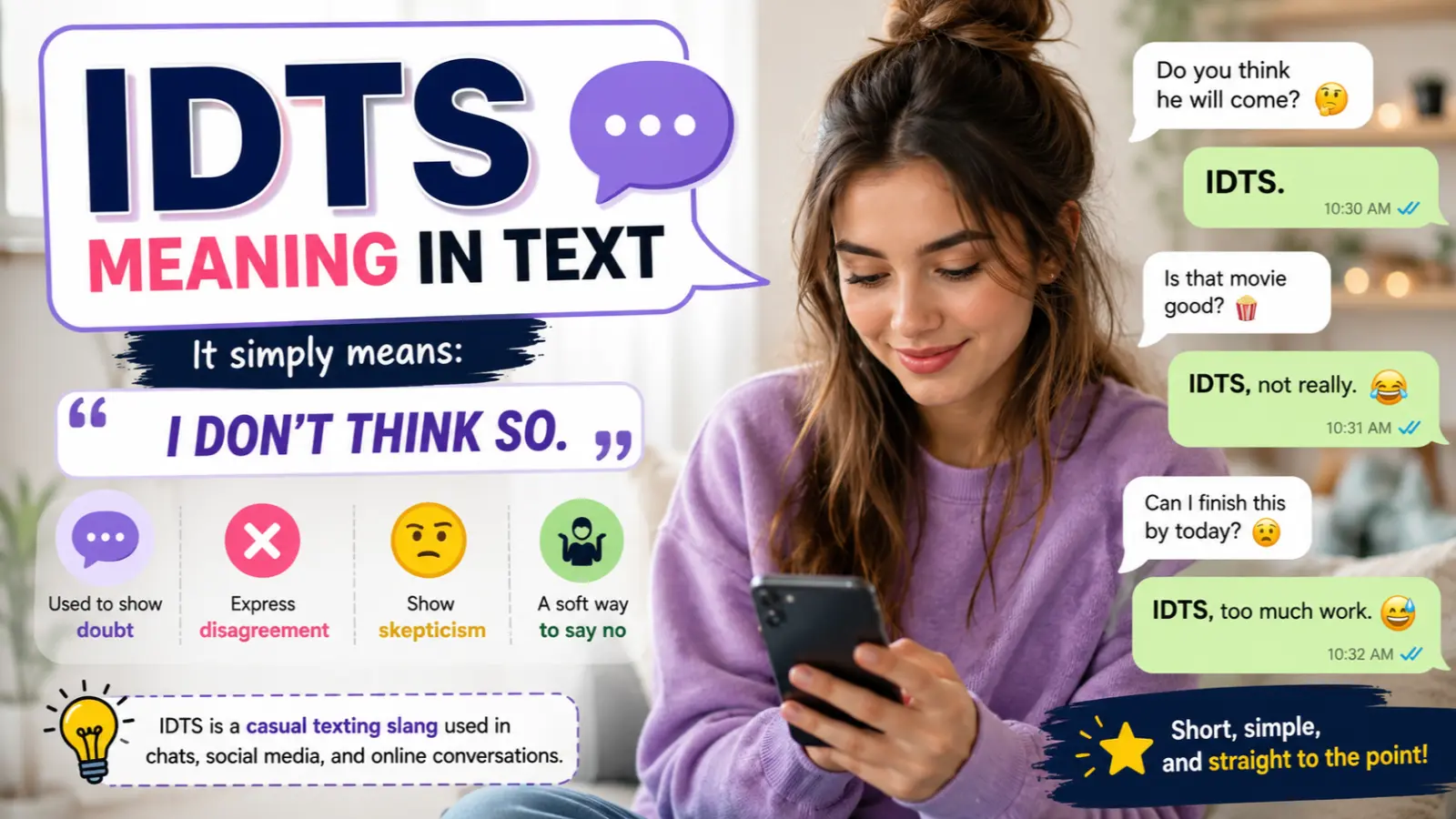
IDTS is a texting and internet abbreviation for “I don’t think so.” People use it in casual messages, social media posts, group chats, and online conversations when they doubt something or disagree with an idea.
The exact tone can change with the conversation. A simple “idts” may sound neutral, while “IDTS 😂” can feel playful or sarcastic.
Quick Answer
IDTS Meaning in Text “I don’t think so.” It is mainly used in texting and online communication to express doubt, disagreement, disbelief, or a mild “no.” The meaning is usually the same, although its tone can range from polite and uncertain to sarcastic or dismissive depending on context.
What Does IDTS Meaning in Text?
In text messages, IDTS = I Don’t Think So.
It is a shortened form of a common English phrase. Instead of typing the whole sentence, someone can simply write IDTS or idts.
For example:
“Do you think Jake is coming tonight?”
“idts.”
Here, the person means:
“I don’t think Jake is coming tonight.”
IDTS does not always mean a firm “no.” The phrase “I don’t think so” leaves some room for uncertainty. The person may believe the answer is no without claiming to be completely certain.
What Does IDTS Express?
The abbreviation can communicate several closely related ideas.
1. Doubt
Someone is not convinced that something is true or will happen.
“Do you think the store is still open?”
“IDTS.”
The speaker thinks it is probably closed.
2. Disagreement
IDTS can show that you do not agree with another person’s opinion.
“That was the best movie of the year.”
“idts 😭”
The reply means, “I don’t think so.”
3. Disbelief
Sometimes IDTS is used when someone thinks a claim sounds unlikely.
“I finished the whole project in 20 minutes.”
“IDTS 💀”
Here, the response can imply, “I don’t believe you.”
4. Mild Rejection
It can also work as a softer way to say no.
“Want to go out tonight?”
“I’m exhausted.”
This is less direct than simply saying “No.”
Is IDTS Rude?
Usually, no. IDTS is an informal abbreviation, but it is not inherently offensive.
Still, the tone depends heavily on how you use it.
Compare these:
- “IDTS, sorry.” → fairly soft
- “idts lol” → casual
- “IDTS 😂” → possibly playful
- “IDTS.” → can sound blunt
- “IDTS 🙄” → may sound dismissive or sarcastic
A one-word reply can sometimes feel colder than a complete sentence because it gives the other person little emotional context.
If you want to avoid misunderstanding, add a short explanation.
“IDTS, I think she already left.”
That makes your meaning clearer.
Where Is IDTS Used?
IDTS fits best in informal digital communication.
You may see it in:
- Text messages
- WhatsApp chats
- Instagram DMs and comments
- Snapchat conversations
- TikTok comments
- Group chats
- Online forums
- Gaming chats
It is also documented as an internet and text-messaging initialism.
It is less suitable for formal writing, such as academic papers, official letters, or professional documents.
IDTS in Real Conversations
Here are some natural examples.
Example 1: Making Plans
Sam: “Are you coming to the party tonight?”
Alex: “I have an early class tomorrow.”
Meaning: Alex probably isn’t coming.
Example 2: Asking About Someone
Mia: “Do you think Sarah likes him?”
Lena: “IDTS. She barely talks to him.”
Meaning: Lena doubts that Sarah likes him.
Example 3: Friendly Disagreement
Chris: “This is definitely the best pizza place here.”
Dan: “idts 😂 The place downtown is way better.”
Meaning: Dan disagrees in a playful way.
Example 4: Disbelief
Tom: “I can run 10 miles without stopping.”
Jay: “IDTS 💀”
Meaning: Jay doubts Tom’s claim.
Example 5: Simple Uncertainty
A: “Is the meeting at 3?”
B: “IDTS. I think it’s at 4.”
Meaning: B is not certain and believes the time is different.
IDTS on Social Media
On social media, IDTS can be more expressive than it is in a private text.
A person might comment:
“This is the greatest song ever. #idts”
Here, IDTS can act as a sarcastic disagreement.
Dictionary.com also lists IDTS as an acronym used in social media and texting, including sarcastic use.
Context matters. If the comment is followed by laughing emojis, a meme, or exaggerated wording, the person may be joking rather than seriously arguing.
IDTS vs. Similar Texting Abbreviations
| Abbreviation | Meaning | Main Difference |
| IDTS | I Don’t Think So | Shows doubt or disagreement |
| IDK | I Don’t Know | Shows lack of knowledge |
| IDC | I Don’t Care | Shows lack of concern |
| IMO | In My Opinion | Introduces a personal view |
| NGL | Not Gonna Lie | Signals honesty or a candid opinion |
| TBH | To Be Honest | Introduces a frank statement |
The easiest distinction is between IDTS and IDK.
If someone says:
“IDK.”
They are saying they do not know.
If they say:
“IDTS.”
They are saying they don’t think that is true or likely.
IDTS vs. “No”
These expressions are close, but they do not always carry the same force.
“No” can sound definite:
“Are you coming?”
“No.”
“IDTS” can sound less certain:
“Are you coming?”
“IDTS.”
This can mean, “I don’t think I am,” rather than an absolute refusal.
That small difference makes IDTS useful when someone wants to express doubt without sounding overly definite.
Is IDTS Used by Girls and Guys?
Yes. IDTS is not specific to any gender.
If a girl, guy, friend, or stranger sends you “idts,” the basic meaning remains “I don’t think so.”
The important clue is the surrounding conversation.
For example:
“Do you think he likes me?”
“idts 😭”
This probably means the person doubts that he likes you.
But:
“Are you coming to dinner?”
“idts, sorry.”
This is more likely a simple, casual refusal.
When Should You Avoid Using IDTS?
Avoid IDTS when clarity and professionalism matter.
For example, do not rely on “IDTS” in:
- Formal emails
- Job applications
- Business reports
- Academic writing
- Official messages
- Important workplace communication
Instead, write the full phrase or explain your position clearly.
For example, instead of:
“IDTS.”
A professional reply could be:
“I don’t think that will be possible.”
Or:
“I don’t believe that is correct.”
These versions make your meaning clearer and sound more professional.
Where Did IDTS Come From?
The exact origin of IDTS as an abbreviation is not clearly established. It follows the broader pattern of internet and texting language, where common phrases are shortened to make casual communication faster.
Older user-generated records show IDTS being used online for “I don’t think so” as far back as the 2000s, while modern reference sources classify it as internet or text-messaging slang.
So, it is safer to describe IDTS as an established texting initialism rather than claim that one specific person or platform invented it.
Common Misunderstandings About IDTS
Does IDTS mean “I don’t understand”?
Not normally.
The standard slang meaning is “I don’t think so.” Some websites may list additional interpretations, but the established texting meaning is the phrase above.
Does IDTS always mean “no”?
Not exactly.
It often points toward no, but it can also express uncertainty or doubt.
Is IDTS offensive?
No. The abbreviation itself is not offensive. However, a short reply can sound dismissive if the conversation is serious.
Should IDTS be uppercase or lowercase?
Both work.
- IDTS
- idts
Lowercase often feels more casual, while uppercase can add emphasis.
Key Takeaways
- IDTS means “I don’t think so.”
- It is mainly used in texting and online conversations.
- It can express doubt, disagreement, disbelief, or mild rejection.
- It does not always mean a firm “no.”
- Tone depends on punctuation, emojis, and the surrounding conversation.
- Use the full phrase instead when writing formally.
FAQs:
What does IDTS meaning in text messages?
IDTS means “I don’t think so.” It is used to show doubt, disagreement, uncertainty, or disbelief.
What does IDTS mean from a girl?
It normally means the same thing: “I don’t think so.” The exact tone depends on what you asked and how she wrote the reply.
IDTS Meaning in Text from a guy?
It means “I don’t think so.” It may express doubt, disagreement, or a casual refusal.
Is IDTS a good or bad response?
It depends on the situation. It is neutral by itself, but a short “IDTS.” can sometimes sound blunt or dismissive.
What is the difference between IDTS and IDK?
IDTS means “I don’t think so,” while IDK means “I don’t know.” IDTS expresses an opinion or judgment; IDK expresses uncertainty about the answer.
Can I use IDTS at work?
You can use it in a very casual workplace chat if your team normally uses slang. For formal communication, write “I don’t think so” or explain your answer more clearly.
Is IDTS still used?
Yes. IDTS continues to appear in texting and online communication, although how often people use any slang abbreviation varies by community and age group.
What does “IDTS 😂” mean?
It usually means “I don’t think so” in a playful or joking way. The laughing emoji can soften the disagreement or signal that the reply is not meant too seriously.
Conclusion
IDTS means “I don’t think so.” It is a simple texting abbreviation used when someone doubts an idea, disagrees with a statement, questions whether something is true, or gives a soft refusal.
The key is to read the context and tone. A friendly “idts 😂” may be playful, while a plain “IDTS.” can feel more direct. If the conversation is formal or sensitive, skip the abbreviation and say what you mean in full.
Once you understand that difference, IDTS is easy to recognize: it is essentially a quick digital way of saying, “I don’t think so.”

Tayyab Hassan is a Master’s graduate, content writer, and contributor at Meanifiy.com. He specializes in creating informative, reader-friendly content that simplifies language, meanings, and educational topics. With a commitment to accuracy and clarity, he helps readers understand complex concepts through engaging and accessible articles.