SYFM Meaning in Text: What Does it mean?
If someone texts “SYFM”, the meaning can be confusing at first. Unlike common abbreviations such as “LOL” or “BTW,” SYFM is often used as a blunt reaction. You may see it in texts, social media comments, Snapchat chats, gaming conversations, or other casual online spaces.
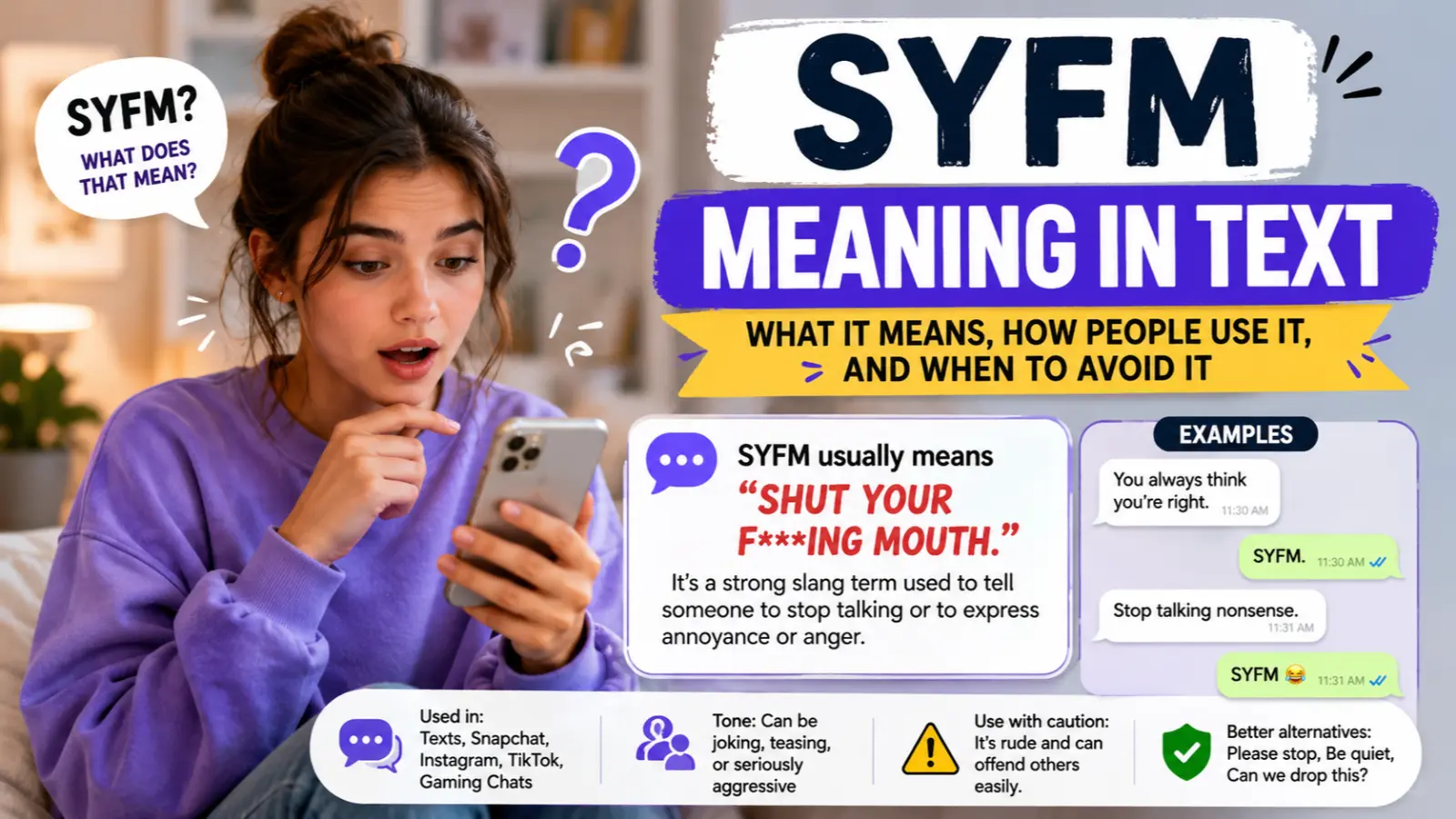
In most cases, SYFM means “Shut Your F*ing Mouth.”** It is a stronger and more vulgar version of “shut your mouth.” People usually use it when they are angry, annoyed, joking aggressively, or telling someone to stop talking.
The exact tone depends on the conversation. Between close friends, it can sometimes be playful. From someone you barely know, it can sound hostile or insulting.
Quick Answer
SYFM Meaning in Text “Shut Your F*ing Mouth.”** It is an informal and profane abbreviation used to tell someone to stop talking or to express strong annoyance. Its meaning is fairly consistent, but its tone can range from joking to genuinely aggressive depending on context.
What Does SYFM Meaning in Text?
In texting, SYFM most commonly stands for:
S = Shut
Y = Your
F = F*ing**
M = Mouth
The phrase is profanity-based, so it is much harsher than simply saying “be quiet.”
Someone might use SYFM after hearing something they find ridiculous, annoying, embarrassing, or unbelievable.
For example:
Alex: “I could beat you at this game with one hand.”
Sam: “SYFM 😂”
Here, Sam may not literally be angry. The laughing emoji suggests playful teasing.
But consider:
Alex: “You never do anything right.”
Sam: “SYFM.”
This version sounds much more hostile.
Is SYFM Rude?
Yes. SYFM is generally considered rude and offensive language.
The word represented by “F” makes the phrase especially strong. Even if the sender intends it as a joke, the recipient may take it seriously.
The relationship between the people matters a lot.
- Close friends: It may be used as joking banter.
- Online arguments: It is usually aggressive.
- Gaming: It can be trash talk or an angry response.
- Strangers: It can easily sound insulting.
- Workplace communication: Avoid it.
If you are unsure how someone will react, it is safer not to use SYFM.
Where Is SYFM Used?
SYFM appears mainly in informal digital communication.
Text Messages
Friends may use it during arguments, jokes, or playful conversations.
Example:
“Bro, SYFM 😂 You actually believed that?”
Snapchat and Instagram
People may use SYFM in private messages, comments, or reactions. The surrounding emojis and conversation often reveal whether it is meant seriously.
TikTok and Social Media
The abbreviation may appear in comments or replies when someone strongly disagrees with another person’s statement.
Gaming Chats
Gaming is another setting where strong abbreviations are common.
Example:
“You got lucky that round.”
“SYFM, I won fair and square.”
In this setting, it can be part of competitive trash talk.
Real Conversation Examples
Here are some natural examples showing different tones.
1. Playful
Mia: “I heard you sing yesterday.”
Jake: “SYFM 😂”
Here, Jake may be joking because of the laughing emoji.
2. Annoyed
Tom: “You need to listen to me.”
Ben: “SYFM. I’m done arguing.”
This sounds genuinely angry.
3. Gaming
Player 1: “You only won because I lagged.”
Player 2: “SYFM bro 😭”
The phrase is being used as competitive banter.
4. Teasing
Sara: “You still owe me $5.”
Lena: “SYFM, I paid you yesterday 😂”
The context suggests a joking response.
5. Online argument
User 1: “Nobody agrees with you.”
User 2: “SYFM.”
This version sounds confrontational.
SYFM vs. Similar Slang
Several abbreviations can express annoyance, but they are not interchangeable.
| Slang | Meaning | Tone |
|---|---|---|
| SYFM | Shut Your F***ing Mouth | Very rude |
| STFU | Shut the F*** Up | Very rude |
| STTM | Shut the Talkin’ Mouth / context-dependent | Less common and variable |
| SHUT UP | Stop talking | Can be rude or playful |
| ZIP IT | Be quiet | Usually lighter |
| BRB | Be right back | Not related to anger |
SYFM and STFU are especially easy to confuse. Both tell someone to stop talking, but SYFM specifically uses “your mouth,” while STFU uses “the f*** up.”
Common Misunderstandings About SYFM
It Does Not Usually Mean Something Polite
SYFM is not a professional or friendly alternative to “please be quiet.” The profanity gives it a strong emotional tone.
The “F” Is Not Usually “For”
In casual texting, people sometimes wonder whether the abbreviation has a harmless meaning. In the common slang usage, the F refers to a profanity.
An Emoji Can Change the Tone
Compare:
“SYFM.”
with:
“SYFM 😂😭”
The first can look angry. The second may be playful, especially between friends.
Still, an emoji does not guarantee that the phrase is harmless.
When Should You Avoid SYFM?
Avoid SYFM when you need to sound respectful or professional.
Do not use it with:
- Employers or managers
- Teachers or professors
- Customers
- Professional clients
- People you do not know well
- Formal emails
- Job applications
- Public professional posts
A safer alternative depends on what you want to say.
Instead of “SYFM,” you could say:
- “Please stop.”
- “Can you stop talking about that?”
- “I’d rather not discuss this.”
- “Please give me a moment.”
- “Let’s drop the subject.”
- “Can we move on?”
These options communicate the same general idea without the profanity.
Does SYFM Mean the Same Thing From a Girl or a Guy?
Usually, yes. SYFM does not have a different standard meaning based on who sends it.
The important factor is the relationship and situation.
If a close friend sends:
“SYFM 😂”
it may be playful.
If someone sends:
“SYFM. Seriously.”
during an argument, it is more likely to be an insult.
So, focus on the conversation, punctuation, emojis, and relationship, rather than the sender’s gender.
Is SYFM Safe to Use on Social Media?
The abbreviation itself is not inherently dangerous, but it contains profanity and can easily create conflict.
Public comments can also be interpreted differently from private jokes. Someone who knows your humor may understand that you are teasing. A stranger may simply see an insult.
If you want to avoid misunderstandings, use a milder phrase.
Key Takeaways
- SYFM usually means “Shut Your F*ing Mouth.”**
- It is an informal and profane texting abbreviation.
- It can express anger, annoyance, teasing, or playful banter.
- Context, emojis, and the relationship between people affect its tone.
- It is common in casual chats, social media, and gaming conversations.
- Avoid it in professional or respectful communication.
FAQs:
What does SYFM Meaning in text?
SYFM usually stands for “Shut Your F*ing Mouth.”** It is a profane way to tell someone to stop talking.
Is SYFM a bad word?
It contains profanity, so it is generally considered rude or offensive. Some friends may use it jokingly, but it can still sound aggressive.
Is SYFM the same as STFU?
They have similar purposes, but they are different abbreviations. SYFM means “Shut Your Fing Mouth,” while STFU means “Shut the F Up.”
Can SYFM be used jokingly?
Yes. Close friends sometimes use SYFM as playful banter. Emojis such as 😂 or 😭 can help show that the sender is joking, but context matters more than the emoji alone.
What does SYFM mean on Snapchat?
On Snapchat, SYFM normally has the same meaning: “Shut Your F*ing Mouth.”** The intended tone depends on the conversation.
Should I use SYFM at work?
No. It is profane and can sound disrespectful. Use a polite phrase such as “Please stop” or “Let’s move on” instead.
What does SYFM mean in gaming?
In gaming chats, SYFM can be used as trash talk, teasing, or an angry response. The competitive setting often makes the tone more playful, but it can still be insulting.
What is a polite alternative to SYFM?
Try “Please stop,” “Can we drop this?” or “I’d rather not discuss that.” These phrases make your point without using profanity.
Conclusion
SYFM meaning in text is usually “Shut Your F*ing Mouth.”** It is a strong, informal abbreviation that tells someone to stop talking or shows intense annoyance.
You may see it in texting, social media, gaming, and casual conversations. Sometimes friends use it jokingly, but it can also be a serious insult. The safest way to interpret SYFM is to look at the surrounding conversation, the sender’s relationship with you, and any emojis or other clues.
If you are speaking professionally or with someone you do not know well, choose a calmer phrase instead.

Tayyab Hassan is a Master’s graduate, content writer, and contributor at Meanifiy.com. He specializes in creating informative, reader-friendly content that simplifies language, meanings, and educational topics. With a commitment to accuracy and clarity, he helps readers understand complex concepts through engaging and accessible articles.