
FOH Meaning Slang: What Does FOH Mean in Text & Social Media?
I have probably seen “FOH” in a text, comment, or social media reply and wondered what the person actually meant. At first glance, it looks like a simple abbreviation, but the tone behind it can change the whole message.
If someone sends me “FOH”, they usually are not being neutral. The expression is commonly used to reject something, show disbelief, or tell someone that their statement is ridiculous.
I may see it in arguments, jokes between friends, TikTok comments, Instagram replies, or casual text conversations. The exact feeling depends on the situation and the relationship between the people talking.
In some conversations, it is playful teasing. In others, it can sound rude or confrontational. So, what does FOH mean in slang, and how should I understand it when someone sends it to me?
Quick Answer
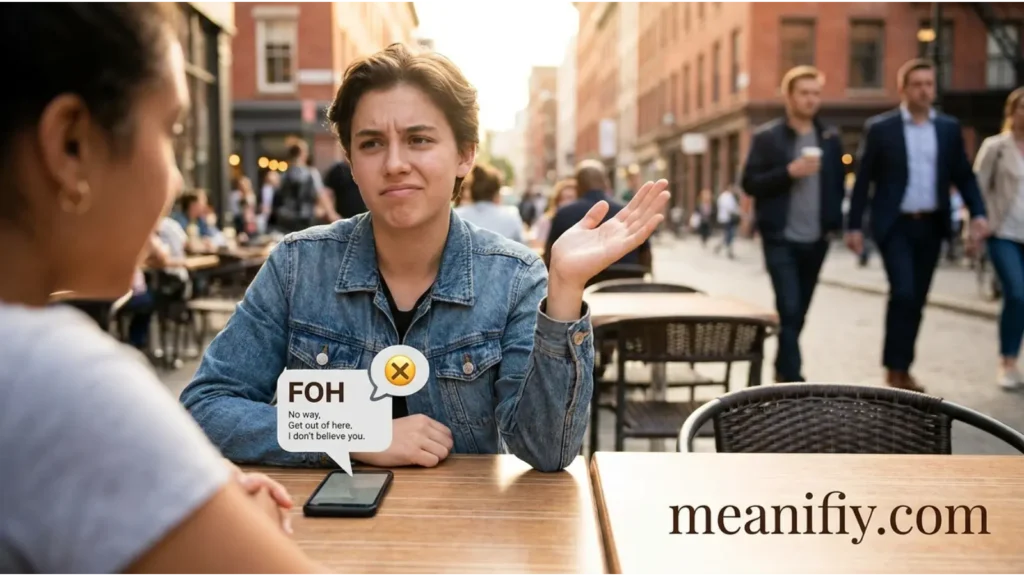
FOH is slang for “F* Outta Here,”** a shortened form of “F* Out of Here.”** In texting and social media, it usually expresses disbelief, rejection, annoyance, or a reaction meaning “No way,” “Get out of here,” or “I don’t believe you.”
What Does FOH Mean in Slang?
The most common meaning of FOH is “F* Outta Here.”**
It is an informal expression people use when they strongly reject what someone has said or done. Depending on the context, it can communicate:
- Disbelief: “I don’t believe you.”
- Dismissal: “Go away.”
- Annoyance: “Stop talking nonsense.”
- Surprise: “Seriously? No way!”
- Playful teasing: “Come on, you’re kidding.”
- Strong disagreement: “That’s ridiculous.”
The important part is tone. The same three letters can be funny between close friends but insulting during an argument.
For example:
Friend: “I finished the whole pizza myself.”
You: “FOH 😂”
Here, FOH could simply mean “Stop lying, I don’t believe you.”
But if someone is arguing and responds with “FOH”, it may be much more aggressive.
Is FOH a Rude Slang Term?
Yes, FOH can be rude because its full form contains profanity.
That does not mean every person uses it aggressively. Online conversations often soften the expression with emojis, humor, or friendly context.
For example:
“FOH 😂😂”
Usually feels more playful.
“FOH. I’m done talking to you.”
Sounds much more hostile.
So I should not judge the abbreviation by itself. I should look at the conversation, punctuation, relationship, and tone around it.
How People Use FOH in Texting
FOH is especially common in casual digital communication where people shorten phrases to react quickly.
1. To Show Disbelief
Someone makes an unbelievable claim:
A: “Bro, I can run faster than everyone here.”
B: “FOH 😂”
Meaning: “I don’t believe you.”
2. To Reject an Excuse
A: “My phone died, that’s why I didn’t reply.”
B: “FOH, you were online all night.”
Here, FOH means something like “I don’t buy that excuse.”
3. As a Joke
A: “I’m definitely the best cook in this group.”
B: “FOH 😭”
The speaker may not genuinely be angry. They are jokingly challenging the claim.
4. To Show Strong Disagreement
A: “That movie was terrible.”
B: “FOH, that was one of the best movies this year.”
Here it works as a strong reaction rather than a literal instruction.
FOH Meaning on Social Media
On platforms such as TikTok, Instagram, Snapchat, and Reddit, FOH can appear in comments or replies when someone strongly reacts to another person’s opinion.
A person might post:
“Nobody listens to old music anymore.”
Someone could comment:
“FOH 😂”
The commenter is essentially saying:
“Come on, that’s obviously not true.”
On social media, the expression can become part of playful internet banter. However, because it contains profanity, it can still come across as disrespectful depending on the audience.
FOH From a Girl or Guy: Does It Mean Something Different?
Not necessarily.
If a girl or guy sends FOH, the basic slang meaning does not automatically change based on who sent it.
What matters more is why they said it.
If someone sends:
“FOH 😂 you really think I’m believing that?”
It is probably playful disbelief.
If they send:
“FOH. Don’t text me again.”
That is much more serious and dismissive.
So I should focus on the surrounding message, rather than assuming the abbreviation has a special meaning because of the sender’s gender.
FOH vs. Similar Slang
It can look similar to several other expressions, but they are not exactly interchangeable.
| Slang | Common meaning | Typical tone |
| FOH | F*** outta here | Strong, dismissive |
| GTFO | Get the f*** out | More aggressive |
| BS | Bullsh*t | Calls something dishonest or ridiculous |
| SMH | Shaking my head | Disappointed or disapproving |
| LOL | Laughing out loud | Amused |
| IDC | I don’t care | Indifferent or dismissive |
FOH is often more confrontational than SMH or LOL, while GTFO can sound even more aggressive.
Common Misunderstandings About FOH
FOH does not always mean “leave”
A literal reading can make it seem like someone is telling another person to physically leave. In online slang, that is often not the intention.
“FOH 😂” may simply mean:
“I don’t believe you!”
FOH is not always serious
Friends may use it as playful banter.
FOH is not automatically an insult
Context matters. Still, because the expression contains profanity, it can easily sound insulting when used with strangers or during conflict.
When Should I Avoid Using FOH?
I would avoid FOH in professional or formal communication.
For example, sending it to a teacher, employer, customer, client, or unfamiliar person could make you sound disrespectful.
Instead of:
“FOH, that’s not true.”
You could say:
- “I don’t think that’s correct.”
- “I don’t agree with that.”
- “I don’t believe that’s accurate.”
- “I think there’s been a misunderstanding.”
These alternatives communicate disagreement without profanity.
Is FOH Safe for Kids?
FOH is not ideal for formal or child-friendly communication because its common full form contains profanity.
A young person may encounter it online, but understanding what it means is different from using it. The safest approach is to recognize that it is strong, informal slang and consider the audience before repeating it.
Key Takeaways
- FOH commonly means “F* Outta Here”** or “F* Out of Here.”**
- It is used to express disbelief, rejection, annoyance, or strong disagreement.
- Friends may use it jokingly or playfully.
- In an argument, it can sound rude or aggressive.
- The surrounding conversation and emojis can change its tone.
- Because it contains profanity, it is best avoided in professional or formal conversations.
Frequently Asked Questions
What does FOH Meaning Slang?
In text messages, FOH usually means “F* Outta Here.”** It can express disbelief, dismissal, annoyance, or playful disagreement.
Is FOH a bad word?
FOH is considered profanity-based slang because its common full form contains an offensive word. Its seriousness depends on the context and audience.
What does FOH mean on TikTok?
On TikTok, FOH is commonly used in comments or replies to express disbelief, disagreement, or humorous rejection of something someone posted.
What does FOH mean from a girl?
The meaning does not automatically change based on the sender being a girl. She may be expressing disbelief, joking with you, rejecting a statement, or showing annoyance.
What does FOH mean from a guy?
It generally has the same meaning from a guy: “F* outta here.”** The actual tone depends on the conversation.
Is FOH the same as GTFO?
They are related, but not exactly the same. FOH can be used as a reaction to something someone said, while GTFO more directly tells someone to leave and can sound more aggressive.
Can FOH be used jokingly?
Yes. Friends sometimes use FOH jokingly when someone makes an exaggerated or unbelievable claim, especially with laughing or crying emojis.
Should I use FOH at work?
Generally, no. FOH is informal profanity-based slang and can sound disrespectful in workplace communication. A neutral phrase such as “I don’t agree” is safer.
Conclusion
When I see FOH in a text or social media comment, I should not automatically assume the person is angry. Most often, it is a strong slang reaction meaning “Fuck Out Here,”** used to show disbelief, rejection, or disagreement.
Among friends, it can be nothing more than playful banter, while in a serious argument it can sound genuinely hostile. The surrounding words, emojis, and relationship between the speakers are what reveal the real tone.
In short, FOH is casual, profanity-based slang, so understanding the context is just as important as knowing its full form.

Tayyab Hassan is a Master’s graduate, content writer, and contributor at Meanifiy.com. He specializes in creating informative, reader-friendly content that simplifies language, meanings, and educational topics. With a commitment to accuracy and clarity, he helps readers understand complex concepts through engaging and accessible articles.